Tag: Pierre Dragicevic

1660 – Galileo Thermometer

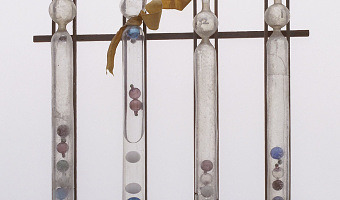
A Galileo thermometer consists of a set of floaters immersed in a clear liquid (typically ethanol) inside a sealed glass tube. Today a floater is typically a glass sphere containing a colored liquid and to which is attached a metallic temperature tag. The composition of a floater is irrelevant, its overall density just needs to be calibrated to a certain value and remain stable. Floaters being made of glass and metal, their volume - and therefore density - is largely unaffected by temperature. […]

Added by: Pierre Dragicevic. Category: Measuring instrument  Tags: italy, science, thermometer


1750 – George Adams' Solid Geometry Models

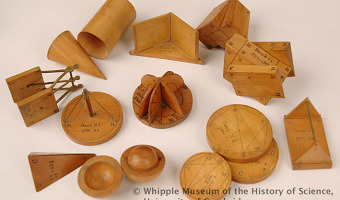
During the 18th century, instrument maker George Adams built and sold solid 3D geometric models as educational complements to the 2D images found in Euclid's Elements of Geometry. As argued by a 18th-century author: It is almost as necessary as in mechanics, to exhibit the objects, whose qualities are to be taught; and to call in the joint assistance of the hands and eyes. According to the Whipple Museum of the History of Science, authors were already experimenting with paper models soon after […]

Added by: Pierre Dragicevic. Category: Physical model  Tags: education, geometry, science, wooden


1887 – Marey's Movement Sculptures

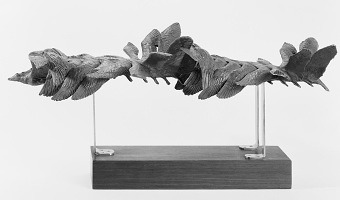
Bronze sculpture showing the phases of the flight of birds, created by French scientist Étienne-Jules Marey in 1887 based on photographs. Étienne-Jules Marey was a pioneer in the study of dynamic phenomena and invented a variety of scientific and medical instruments, photography techniques, and temporal visualization methods. A wealth of information is available about him online. Sources: Russel Naughton (2007) Aviation and Aeromodeling History - Étienne-Jules Marey (1830 - 1904). Wikipedia […]

Added by: Pierre Dragicevic. Category: Physical model  Tags: temporal data


2000 – Kanban Boards

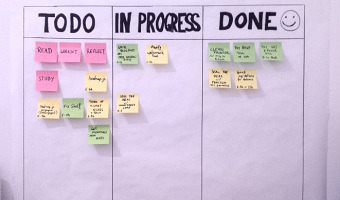
A Kanban board is a task management tool where sticky notes representing work items are moved across a board to reflect their state of advancement. The simplest form has three states: to do, in progress, and done (left image). A Kanban board provides a visual overview over all work items that makes it possible to rapidly spot time management issues, such as too many items in progress. Although software versions exist, many people prefer Kanban boards to be physical. Several recent blog posts […]

Added by: Pierre Dragicevic. Category: Uncertain  Tags: manual update, task management


2009 – Marcovici's Single-Datum Visualizations

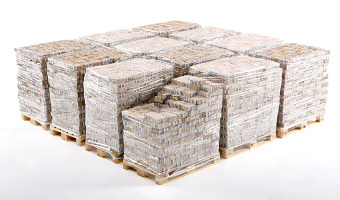
Vienna artist Michael Marcovici created two physical visualizations that convey a single numerical value. The first one shows one billion dollar - the most expensive piece of art ever made, according to him (although these were actually miniature bills). The second one called Rolex Time Sand shows an entire lifetime worth of hourglass sand. For another single-datum physical visualization see our entry Ceramic Poppies to Commemorate Fallen Soldiers in WW1, and our entry on Chris Burden's […]

Added by: Pierre Dragicevic. Category: Passive physical visualization  Tags: concrete scale, large numbers, money, single-datum, time


2011 – Jose Duarte's Handmade Visualization Toolkit

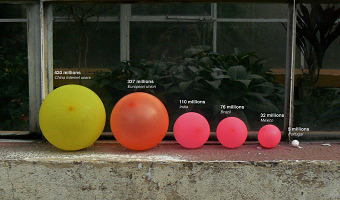
Colombian designer Jose Duarte wants to bring the DIY concept to data visualization. Using ordinary materials like balloons, tape and rubber balls, he has experimented with various visualization techniques from area charts to bubble graphs and ven diagrams in diverse scenarios as business, art, street interventions and even astronomy. To help people build physical visualizations he designed a physical toolkit he calls the Handmade visualization toolkit. Sources: Maria Popova (2011) Analog […]

Added by: Pierre Dragicevic. Category: Passive physical visualization  Tags: authoring, charts, hand-made, toolkit


2011 – Stephen Barrass' Physical Data Sonifications

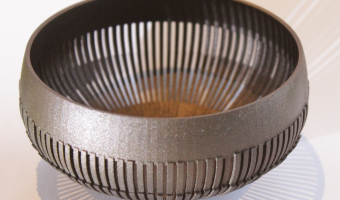
Physical representations of data can target other senses than vision or touch. Stephen Barrass, one of the inventors of sonification in the late 90s and now at the University of Canberra, started to explore physical sonifications in 2011. He calls this principle Acoustic Sonification: Acoustic Sonifications are physical objects designed to make sounds that convey useful information about a dataset of some kind. Unlike other sonifications, they do not require a power supply, and the sounds are […]

Added by: Pierre Dragicevic, sent by: Yvonne Jansen. Category: Passive physical visualization  Tags: blood pressure, data jewellery, health, HRTF, sonification, sound, steel


2014 – Data Clothing: Dresses Show Air Pollution

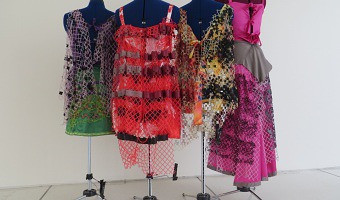
Laura Perovich explored the concept of data-driven clothes as part of her Master thesis at the MIT Media Lab. The fashion dresses above show the concentrations of 100 chemical contaminants measured in the air of a particular household (left image). Chemicals are mapped to small squares and relative concentration is mapped to square size. Squares are repeated to create lace patterns (right image shows the concentration of several factory-related pollutants). In her thesis Laura Perovich […]

Added by: Pierre Dragicevic, sent by: Yvonne Jansen. Category: Passive physical visualization  Tags: air pollution, data clothing, digital fabrication, environment, textile


2014 – Cosmos: Carbon Exchange Captured in a Wooden Ball

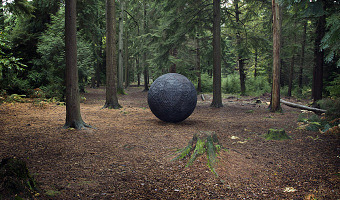
Artist duo Ruth Jarman and Joe Gerhardt created this two-meter spherical wooden sculpture located in a forest in England, and representing the take up and loss of carbon dioxide from the forest trees across one year. Watching the video, I was somehow expecting this sphere to roll at some point, but it did not happen. Source: Semiconductor (2014) Cosmos.

Added by: Pierre Dragicevic, sent by: Mathieu Le Goc. Category: Passive physical visualization  Tags: air pollution, carbon emission, data sculpture, digital fabrication, milling, sustainability, wooden


2033 – Cetonia: Drone Swarm Visualizations

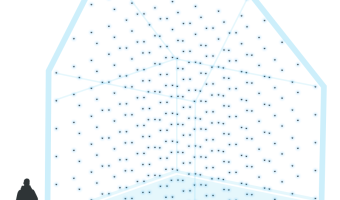
As part of the VIS'14 Workshop Death of the Desktop, infovis researcher Wesley Willett imagines how nano drone swarms may be used in 2033 both to capture and visualize data directly in the real world: At barely 1.5 centimeters across, each Cetonia scarab is a marvel of precision engineering. Designed from the ground up for agile flight, their integrated hydrogen chambers and a high-efficiency hover mode permit 15+ minutes of air time between charges. The hueSHIFT carapace is capable of […]

Added by: Pierre Dragicevic. Category: Enabling technology  Tags: future, nano drones