Tag: Pierre Dragicevic

1898 – Tallies Used as Social Displays on Pacific Islands

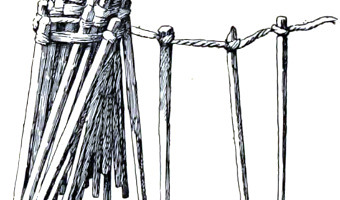
In the 19th century, the Torres Strait Islanders did not have a numeral system and used sticks to keep counts. Sticks were tied to a string, forming a bundle (called kupe) that could be rolled and unrolled when needed. Kupes were typically used by men to keep track of their accomplishments, such as turtles caught in deep water, fishes speared, or adventures with women (as the one above). These physical visualizations were used as social displays, and big kupes were greatly prized. According to […]

Added by: Pierre Dragicevic. Category: Passive physical visualization  Tags: anthropology, preliterate, self-logging, social use, tally

1992 – Durrell Bishop's Marble Answering Machine

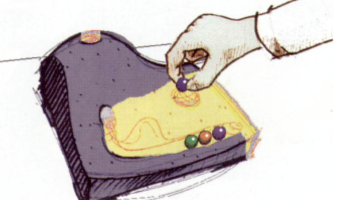
In 1992, Durrell Bishop, then a student at the Royal College of Art, came up with an original answering machine design that is considered as one of the first tangible user interfaces (TUIs). The machine spits out a marble each time an incoming voice message is recorded. The order of the marbles indicates the order in which the messages arrived. Messages can be played back by putting a marble in a small dent. If the message is for somebody else it can be placed on a small dish to the side that […]

Added by: Pierre Dragicevic. Category: Active physical visualization  Tags: answering machine, design, marble, tangible user interface


2006 – Peter Jansen's Movement Sculptures

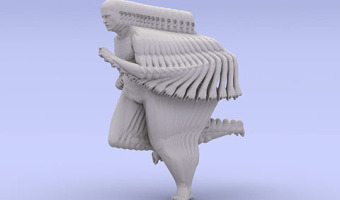
Dutch artist Peter Jansen creates sculptures of moving characters by merging successive snapshots into a single monolithic object. These are not physical visualizations as they do not display data, but the technique could certainly inspire the creation of physical visualizations for complex temporal data. The idea of merging time slices is reminiscent of the pioneering work of Étienne-Jules Marey in the 1880s on chronophotography. See our entry on Marey's movement sculptures. Source: Peter […]

Added by: Pierre Dragicevic. Category: Physical model  Tags: sculpture, temporal data


2012 – Google Eye: Radial Visualization of Page Visits

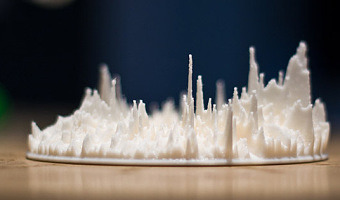
During the Generator.x 3.0 workshop, interaction designer Andrej Boleslavský created a radial visualization of page visits where each day spans a specific angle of the ring, and the entire ring spans one year. Source: Andrej Boleslavský (2012) Google Eye.

Added by: Pierre Dragicevic, sent by: Mathieu Le Goc. Category: Passive physical visualization  Tags: 3d printing, digital fabrication, page visits, temporal data


2013 – 3D Social Networks

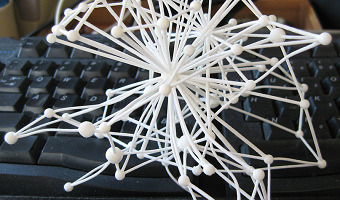
Jeff Hemsley from Syracuse University explains how to create solid models of social networks using the statistical package R and a 3D printer. 3D node-link diagrams have been explored for a while due to their potential benefits. One is that any node-link diagram can be laid out in 3D without any link crossing. Some studies have also shown that in some cases 3D node-link diagrams are easier to read than 2D ones. However, 3D visualizations are generally hard to navigate and to perceive on regular […]

Added by: Pierre Dragicevic, sent by: Jeff Hemsley. Category: Passive physical visualization  Tags: 3d printing, digital fabrication, network, social network


2013 – Motion Structures: Videos as Space-Time Objects

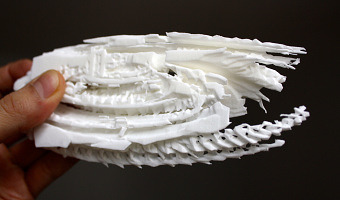
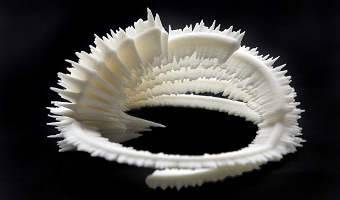
Everardo Reyes-Garcia from Université Paris 13 turns video sequences into space-time shapes that can be 3D printed. The sculpture above represents 5 seconds of the opening theme of Game of Thrones. Source: Everardo Reyes-Garcia (2013) Motion Structures. Related: Also see our entry 2006 – Peter Jansen's Movement Sculptures.

Added by: Pierre Dragicevic, sent by: Aurélien Tabard. Category: Physical model  Tags: 3d printing, digital fabrication, space-time cube, temporal data, video


2013 – Flip Books Rather Than Movies

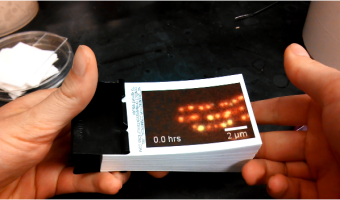
Cell biologist Jessica Polka discusses the benefits of making flip books to bring to scientific conferences: With the advent of smartphones and tablets, bringing movies to poster sessions is becoming more common than ever before. Even so, a low-tech flip book is still a lot more fun for visitors to use, and it's easier to pass around a large group. When the session's over, a flip book can live at your bench indefinitely, ready for visitors with no boot time. Source: Jessica Polka (2013) Hands […]

Added by: Pierre Dragicevic, sent by: Benjamin Bach. Category: Other  Tags: animation, flip book, science


2013 – Data Sculpture of Chicken Inbreeding

Ryo Sakai and Jan Aerts from the Bioinformatics/Data Visualization Lab at KULeuven created a data-driven sculpture representing inbreeding in a particular chicken. Each loop in the sculpture represents a chromosome. On the outside is a histogram of the heterozygosity of the DNA; the inside a histogram of the homozygosity in that region. These sculptures are part of the Cosmopolitan Chicken Project, and have been presented at the Art Biennale in Venice. Source: Text and images from Jan Aerts.

Added by: Pierre Dragicevic, sent by: Jan Aerts. Category: Passive physical visualization  Tags: 3d printing, bio-engineering, digital fabrication, dna, science


2030 – Digitally-Fabricated Visualizations of the Future

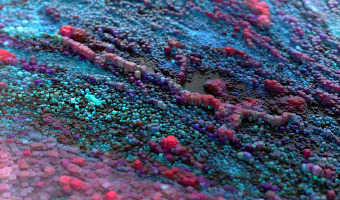
These images have nothing to do with physical visualizations: they are not data-driven but abstract, and they are not even physical but instead photo-realistic computer-generated images. However, these images from digital artist Lee Griggs give an idea of what physical visualizations may look like in the near future once we overcome the limitations of today's digital fabrication technology: they will be visually and haptically elaborate, colorful, rich, and beautiful. Make sure you look at the […]

Added by: Pierre Dragicevic, sent by: Benjamin Bach. Category: Enabling technology  Tags: future


2060 – Programmable Matter

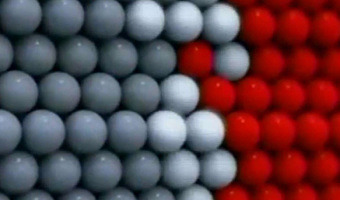
In 1965 Ivan Sutherland already mentioned programmable matter as the ultimate computer display: The ultimate display would, of course, be a room within which the computer can control the existence of matter. A chair displayed in such a room would be good enough to sit in. Handcuffs displayed in such a room would be confining, and a bullet displayed in such a room would be fatal. With appropriate programming such a display could literally be the Wonderland into which Alice walked. Several […]

Added by: Pierre Dragicevic. Category: Enabling technology  Tags: claytronics, future, programmable matter, radical atoms