Tag: Pierre Dragicevic

150 BC – Greek Orrery

An orrery is a mechanical model of the solar system. The left image shows the Antikythera, the oldest known orrery. The middle image shows a virtual reconstruction. The right image shows a contemporary orrery. The Antikythera mechanism is an ancient analog computer designed to predict astronomical positions and eclipses. It was recovered in 1900–01 from the Antikythera wreck, a shipwreck off the Greek island of Antikythera. The instrument was designed and constructed by Greek scientists and has […]

Added by: Melanie Bacou & Pierre Dragicevic. Category: Physical model  Tags: astronomy, greece, mechanical interaction, physical computation, pragmatic, science, time

1901 – Davenport's Physical Distributions

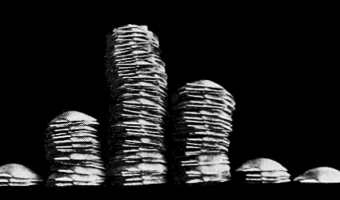
In 1901, biologist Charles Davenport "built" physical visualizations that show the distributions of features of objects and people. These visualizations were made out of the objects and the people themselves. The purpose was to explain the notion of statistical distribution to a lay audience. On the left image, seashells are piled up according to how many ribs they have. On the middle image, students are arranged in bins according to their height. On the right image, they are simply sorted. […]


1985 – Using the Physical to Explain the Virtual

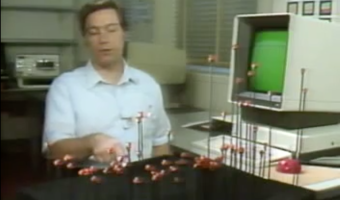
In this 1985 video, Rick Becker from AT&T Bell Labs explains the concept of "dynamic graphics". Already in the early 70s, statisticians like John Tukey were starting to experiment with multidimensional data visualization on flat computers screens, including 3D data visualizations that could be interactively rotated to convey depth. This video shows how enthusiastic these people were to transition from the physical to the virtual. Nevertheless, it is interesting to see that Rick Becker felt […]

Added by: Pierre Dragicevic. Category: Passive physical visualization  Tags: 3d scatterplot, statistical graphics


2012 – Large-Scale Drone Swarm

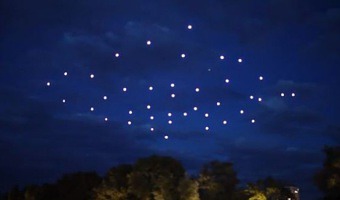
Floating spheres again, but this time there is no wire. An outdoor demonstration of 49 quadrocopters in a synchronized motion, by Ars Electronica Futurelab and Ascending Technologies GmbH. Sources: The Blaze (2012) Also watch another demonstration involving 20 small quadrocopters indoors by the GRASP Lab at the University of Pennsylvania (2012).

Added by: Pierre Dragicevic. Category: Enabling technology  Tags: drones, quadrocopters


2013 – Robot Arranges 8,000 Nails Into a Data Sculpture of the Wind

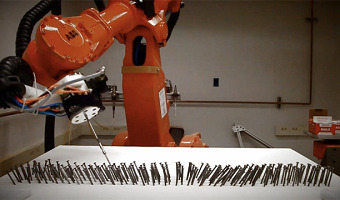
Student and interaction designer Charles Aweida used a foam board, a robot and lots of nails to build a physical visualization of a wind simulation. Sources: Charles Aweida (2013) An exploration in art + robotics representing wind through digital fabrication and the tangible. Via The Creator Project (2013) Data Sculpture Of The Wind Created Using A Robot And Lots Of Nails.

Added by: Pierre Dragicevic. Category: Passive physical visualization  Tags: digital fabrication, foam board, nails, robot, wind


2013 – Behavioral Landscapes

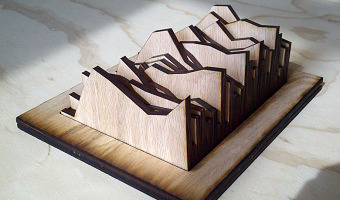
A mixed team of artists and scientists at Pennsylvania State University devised a method to visualize human behavior, personality and emotions as 3D probability density functions. They then produced solid models using CNC milling. Sources: Studio|Lab (2013) Behavioral Landscapes. Nilam Ram, Michael Coccia, David Conroy, Amy Lorek, Brian Orland, Aaron Pincus, Martin Sliwinski, and Denis Gerstorf (2013) Behavioral Landscapes and Change in Behavioral Landscapes: A Multiple Time-Scale Density […]

Added by: Pierre Dragicevic. Category: Passive physical visualization  Tags: behavior, personality, psychology


2013 – Line Charts of Cortisol Levels

This data sculpture created by Nilam Ram from the Studio|Lab team at Penn State University shows the evolution of cortisol levels for 34 people after they experienced a stressful situation. Source: Nilam Ram (2013) Cortisol Data Sculpture.


2013 – Quickly Authoring Physical Visualizations

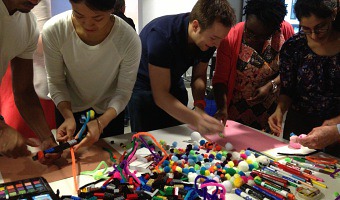
Rahul Bhargava animates workshops where he has participants quickly build physical visualizations using raw material. One of the workshop's goals is to develop people's visual literacy. Source: Rahul Bhargava (2013) Activities for Building Visual Literacy. datatherapy.wordpress.com.

Added by: Pierre Dragicevic. Category: Enabling technology  Tags: authoring, visual literacy


2013 – SweatAtoms: Physical Activity Sculptures

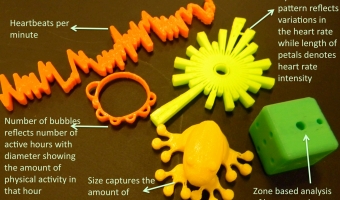
Rohit Ashok Khot is a PhD student at the Exertion Games Lab at RMIT University in Melbourne who studies how physical visualizations of self-logged physical activity data can enhance the experience of exercising and perhaps provide an incentive for exercising more. Sources: Khot et al (2013) SweatAtoms project page Khot et al (2014) Understanding Physical Activity through 3D Printed Material Artifacts

Added by: Pierre Dragicevic. Category: Passive physical visualization  Tags: physical exercise, self-logging


2014 – Building Visualizations with Tokens

Samuel Huron and his collaborators show how anyone can build their own visualizations by assembling physical tokens. Sources: Samuel Huron, Sheelagh Carpendale, Alice Thudt, Anthony Tang, Michael Mauerer (2014) Constructive Visualization (Web Page) Samuel Huron, Yvonne Jansen and Sheelagh Carpendale (2014) Constructing Visual Representations: Investigating the Use of Tangible Tokens (Web page)