Tag: Pierre Dragicevic

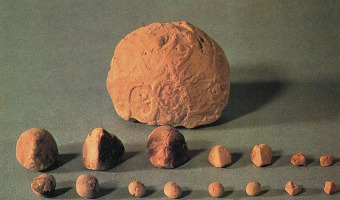
5500 BC – Mesopotamian Clay Tokens

The earliest data visualizations were likely physical: built by arranging stones or pebbles, and later, clay tokens. According to an eminent archaeologist (Schmandt-Besserat, 1999): "Whereas words consist of immaterial sounds, the tokens were concrete, solid, tangible artifacts, which could be handled, arranged and rearranged at will. For instance, the tokens could be ordered in special columns according to types of merchandise, entries and expenditures; donors or recipients. The token system […]

Added by: Pierre Dragicevic. Category: Passive physical visualization  Tags: anthropology, archaeology, clay, mesopotamians, rearrangeable
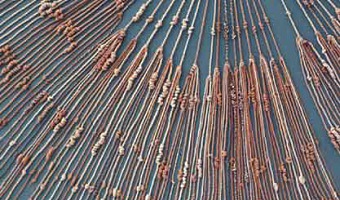

2600 BC – Quipus

Quipus were complex assemblies of knotted ropes that were used in South America as a data storage device and played an important role in the Inca administration. Only a handful of specialists could use and decipher them. Their meaning mostly remains a mystery but it seems that color, relative position of knots, knot types and rope length were used to encode categorical and quantitative variables. The oldest known Quipu is 4600 years old. In the late 16th century quipus were still being used by […]

Added by: Pierre Dragicevic. Category: Passive physical visualization  Tags: anthropology, incas, knots, peru, quipu


1839 – Théodore Olivier's String Models

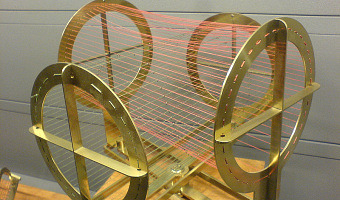
Between 1839 and 1853 the French mathematician Théodore Olivier created string models to teach and demonstrate descriptive geometry, some of which could be manipulated. He was a student of French mathematician Gaspard Monge, who invented descriptive geometry and was already illustrating his ideas with rudimentary string models. Photo above: intersection of two cylinders. Sources: Nicholas Mee (2013) Strings, Surfaces and Physics. Photo above taken in the Musée des Arts et Métiers in Paris, see […]

Added by: Pierre Dragicevic. Category: Physical model  Tags: geometry, mathematics, mechanical interaction, teaching


1880 – Klein's Mathematical Plaster Models

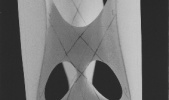
In the 19th century, mathematicians became interested in the question how mathematical functions look like. Felix Klein, a German mathematician, had several of such physical models in his lab in Göttingen, and popularized them in America when he brought a boatload to the World's Fair in Chicago in 1893. The photo above shows a model of a Clebsch surface from 1880, designed and presumably built by Adolf Weiler, Klein's grad student. It is kept today at the University of Göttingen. Sources: Photo […]

Added by: Yvonne Jansen & Pierre Dragicevic, sent by: Saiganesh Swaminathan. Category: Physical model  Tags: education, mathematical functions, plaster


1914 – Solid 3D Curves for Engineering

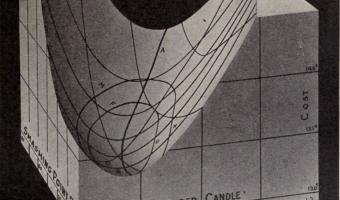
In his 1914 book, Brinton discusses various techniques for building solid models of three-dimensional charts and functions for the purposes of engineering, and uses the two designs above as examples. Although these don't look like they could be solid models, the text from Brinton's book suggests they are. The first one (left) is made of plaster and shows the characteristics of a light bulb. The second (right) is made of cardboard and shows the results of tests of a fan. The two artifacts are […]

Added by: Pierre Dragicevic. Category: Passive physical visualization  Tags: 3d curves, engineering, industry, technology


1951 – Microtiter Plates

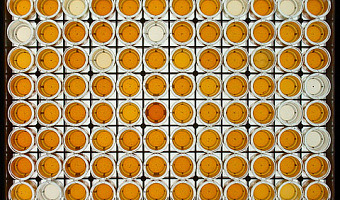
A microtiter plate is an array of chemical test tubes called "wells", invented in 1951 by a Hungarian medical doctor. They are used in a variety of experimental designs, most typically biochemistry assays. The picture above is an example of a colorimetric assay result. Most of the time, they are not directly interpreted visually, as in this example, but are instead put into a plate reader that measure light transmission in each well and converts it to a numerical result. See an example catalog […]

Added by: Pierre Dragicevic, sent by: Jon Hill. Category: Uncertain  Tags: indexical, microtiter, physical computation, science


1970 – 3D Sankey Diagram

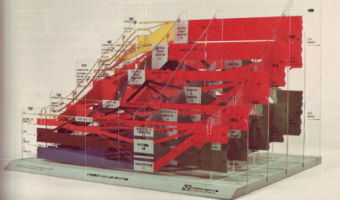
This physical 3D Sankey diagram shows complex energy flows and was created in the 70s by the Center for Strategic & International Studies (CSIS). Little information is available about it. It seems to be composed of five layers of transparent sheet, with four additional layers running perpendicularly. Physical size unknown. Source: Energy Education References Wiki. Energy Flow Diagrams 1949-2009.

Added by: Pierre Dragicevic. Category: Passive physical visualization  Tags: energy, Sankey diagram


2009 – Leithinger's Interactive Shape Displays

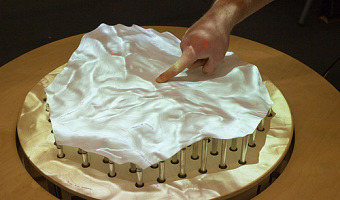
Daniel Leithinger, PhD student at MIT MediaLab and his colleagues, are studying interaction with shape displays. The team designed two impressive shape displays made of arrays of ultra-fast motorized pins. Relief (2009-2010, first row above) is made of 120 motorized pins on top of which can be added a rubber sheet and a projected image. Each pin can be addressed individually and senses user input like pulling and pushing. In 2011, the team extends Relief (later renamed Recompose, second row […]

Added by: Pierre Dragicevic. Category: Active physical visualization  Tags: cartographic, interaction, MIT, shape display


2010 – Data Sculptures in Class

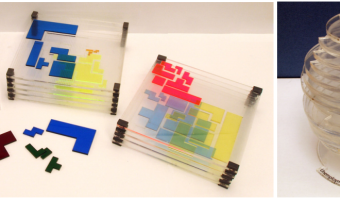
The two data sculptures above have been created by undergraduate students as part of a design class given by Andrew Vande Moere at the University of Sydney. A 2010 article he coauthored with Stephanie Patel (link below) provides many other examples of these. Andrew Vande Moere has published several articles on data sculptures since 2008. Sources: Andrew Vande Moere and Stephanie Patel (2010) The Physical Visualization of Information: Designing Data Sculptures in an Educational Context. Also see […]

Added by: Pierre Dragicevic. Category: Passive physical visualization  Tags: data sculptures, education


2012 – Rearrangeable 3D Bar Chart

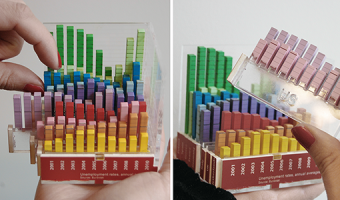
A modular physical visualization like this rearrangeable 3D bar chart allows people to sort, filter, compare and examine data by direct physical manipulation. Sources: Yvonne Jansen and Pierre Dragicevic (2013) An Interaction Model for Visualizations Beyond the Desktop. Also see Yvonne Jansen's PhD dissertation on Physical and Tangible Information Visualization (2014)

Added by: Pierre Dragicevic. Category: Passive physical visualization  Tags: bar chart, rearrangeable