Tag: Pierre Dragicevic

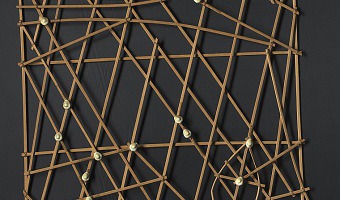
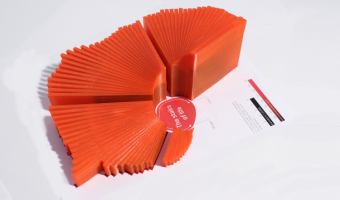
1862 – Marshall Islands Stick Charts

These physical visualizations show ocean swell patterns, and were built by native Micronesians from the Marshall Islands to facilitate canoe navigation. They were memorized before trips. The Western world remained unaware of the existence of these artifacts until 1862. The photo above is a stick chart from 1974. Straight sticks represent regular currents and waves, curved sticks represent ocean swells, and seashells represent atolls and islands. Sources: Wikipedia. Marshall Islands Stick […]

Added by: Pierre Dragicevic. Category: Passive physical visualization  Tags: anthropology, cartographic, marshall islands, stick chart


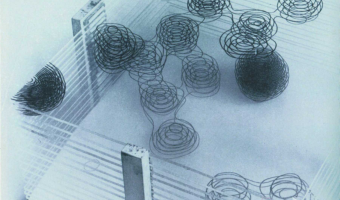
1947 – Dorothy Hodgkin's Electron Density Contours

Nobel prize winning crystallographer Dorothy Crowfoot Hodgkin created another physical visualization in the mid 1940's, showing part of the structure of penicillin. An original of this artifact is in the Oxford Museum of the History of Science. This technique recently inspired artist Angela Palmer for her glass portraits. Sources: Lachlan Michael and David Cranswicka (2008) Busting out of crystallography's Sisyphean prison: from pencil and paper to structure solving at the press of a button: […]

Added by: Pierre Dragicevic, sent by: Jean-Baptiste Labrune. Category: Passive physical visualization  Tags: chemistry, crystallography, penicillin, science, glass


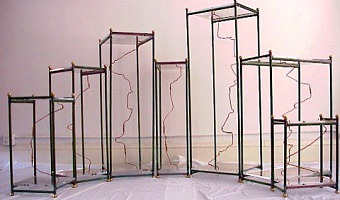
2003 – Time Pieces: Physical Space-Time Cubes

Artist Marilynn Taylor created seven three-dimensional maps (one for each day of the week) in which time is the z-axis and a copper wire shows how she moved across the city during the day. Source: Maryline Taylor (2003) Time pieces - Mapping the time and space of place (2003 version).

Added by: Pierre Dragicevic, sent by: Benjamin Bach. Category: Passive physical visualization  Tags: hand-made, temporal data


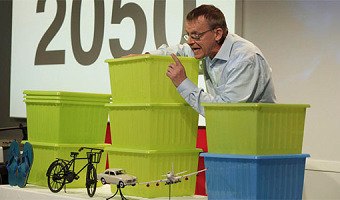
2010 – Hans Rosling Adopts Physical Visualizations

Hans Rosling is famous worldwide for his fascinating speeches about population growth and income inequalities, notably his 2006 TED Talk where he debunks myths about the third world using animated charts. In 2010 he started to tell stories about data using physical visualizations. He started by stacking Ikea boxes, then switched to a variety familiar objects including pebbles, toy construction kits, fruit juice, snow balls and even toilet paper. Hans' son Ola Rosling is behind the technology […]

Added by: Pierre Dragicevic & Yvonne Jansen. Category: Passive physical visualization  Tags: LEGO, rearrangeable, storytelling, TED


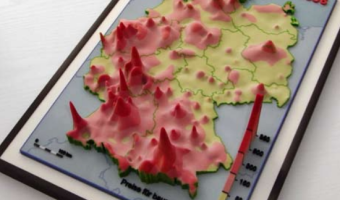
2010 – Thematic Maps of Germany

Physical cartographic visualizations built by geographer Wolf-Dieter Rase with a Z650 printer. Left: average prices for building lots in Germany in 2006. Middle: unemployment in Germany in 2006; The surface represent trends, the columns represent local deviations from the trends (magenta means higher, cyan means lower). Right: travel distance to airports. Source: Wolf-Dieter Rase (2012) Creating Physical 3D Maps Using Rapid Prototyping Techniques.

Added by: Pierre Dragicevic. Category: Passive physical visualization  Tags: 3d printing, cartographic


2010 – Shanghai Spheres

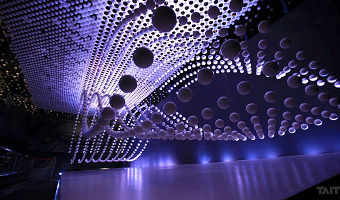
For the 2010 World Expo at Shanghai, Japanese firms ADK and Murayama and Las-Vegas firm Fisher Technical Services, Inc. created an array of 1,008 15cm diameter actuated spheres, each suspended by its own micro winch. The show does not include data visualizations. Kinetic sculptures made of arrays of suspended spheres abound. An early one is Joe Gilbertson's (2007). More recent ones include Kinetic Rain (2012) and Triptych (2014). Also check 2008 – BMW Kinetic Sculpture on this list. Source: […]

Added by: Pierre Dragicevic. Category: Enabling technology  Tags: large-scale, self-actuated, shape display, kinetic sculpture


2010 – Headspace: Array of Actuated Bars

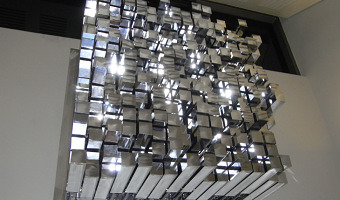
Artist Geoffrey Drake-Brockman created Headspace, a matrix of 256 motorized bars (total size 150 x 150 x 80cm) to display the faces of over 700 schoolchildren. Not a data visualization, but could be used as such. Source: Geoffrey Drake-Brockman (2010). http://www.drake-brockman.com.au/

Added by: Pierre Dragicevic. Category: Enabling technology  Tags: shape display


2012 – Putting Physical Visualizations to the Test

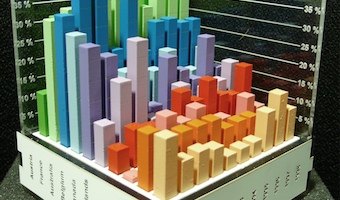
These physical bar charts, showing the evolution of country indicators over time, were used to conduct the first empirical study showing that physical visualizations can outperform their on-screen counterparts for data retrieval tasks. Sources: Yvonne Jansen, Pierre Dragicevic and Jean-Daniel Fekete (2013) Evaluating the Efficiency of Physical Visualizations. Related: Also see Yvonne Jansen's PhD dissertation on Physical and Tangible Information Visualization (2014).

Added by: Pierre Dragicevic. Category: Passive physical visualization  Tags: bar chart, study


2012 – Matthijs Klip's Data Sculptures

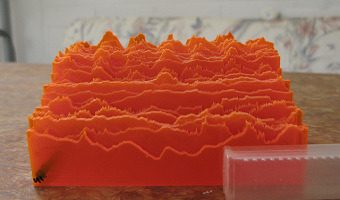
Left image: data sculpture by Dutch designer Matthijs Klip showing life expectancy of the Netherlands population. Each bar maps to an age; the bar's height represents life expectancy while its length represents the amount of people having that age. Right image: other designs by Matthijs Klip. Source: Matthijs Klip (2012) Physical Information Design.