Tag: Pierre Dragicevic

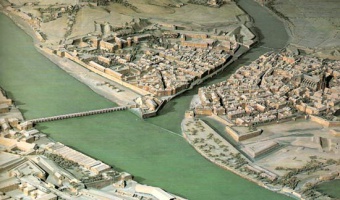
1500 – Plans-Reliefs

The first terrain/city models date back from the 16th century and were created for military purposes. Left image: a plan-relief of Bayonne, created by Sébastian Vauban (1633–1707), a famous fortification engineer of King Louis XIV. Right image: a plan-relief of Grenoble from 1848. These scale models were highly prized for the tactical advantage they brought, and they were also shown around for dissuasive purposes. “Il y a un relief de Namur dans les Tuileries, je vous demanderai d'avoir la […]

Added by: Pierre Dragicevic. Category: Physical model  Tags: cartographic, plan relief, terrain model, walkable
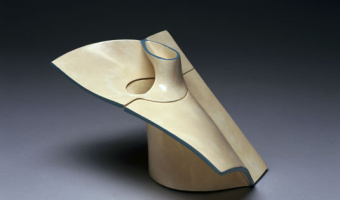

1900 – Crum Brown's Mathematical Surface

Model by Alexander Crum Brown (1838-1922) of a half-twist mathematical surface, featuring a non-Euclidean so-called Klein bottle, c. 1900. Sources: Photo from the Science Museum, London, textual description courtesy of Klaus Hentschel. For more, see Klaus Hentschel (2014): Visual Cultures in Science, Technology and Medicine, pp. 96ff. and pl. XIV.

Added by: Pierre Dragicevic, sent by: Klaus Hentschel. Category: Physical model  Tags: mathematics, science


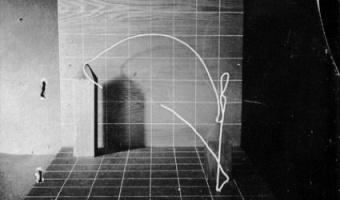
1915 – Wire Models of Factory Worker Movements

3D wire models of hand motion paths (or chronocyclegraphs) created by Frank Gilbreth, a pioneer in the study of motion in the workplace. In his 1917 book, Gilbreth explains how he created these solid models from time-lapse photographs, and how useful they are to study and teach human motion. Left image: Wire model of foreman on drill press. This shows “positioning” in the midst of “transporting.” Right image: First photograph of wire models showing one man's progress of learning paths of least […]

Added by: Pierre Dragicevic. Category: Passive physical visualization  Tags: factory, hand movement, pragmatic, temporal data, wire


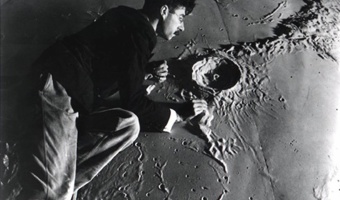
1934 – Hayward's Moon Model

Illustrator and model-maker Roger Hayward (1899-1979) working on a model of the lunar surface for the Griffith Planetarium, 1934. Sources: Kevin Kidney (2009) Mr. Hayward's Moon Model. Photo from Keven Kidney's blog, textual description courtesy of Klaus Hentschel. For more, see Klaus Hentschel (2014): Visual Cultures in Science, Technology and Medicine, pp. 217-226.

Added by: Pierre Dragicevic, sent by: Klaus Hentschel. Category: Physical model  Tags: cartographic, globe, moon


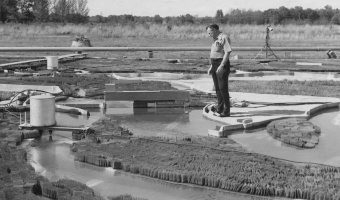
1949 – Mississippi River Basin Model

As a response to devastating floods of the Mississippi river in the early 1900s, the US Army Corps of Engineers built a large-scale hydraulic model of the entire river system. The model, 2.5 times the size of Disneyland, allowed them to design better flood control infrastructures and to eventually save millions of dollars. In 1973, the physical model ceased to be used and was replaced by computer models. Nevertheless, mathematical equations still cannot capture all the complexity of river […]

Added by: Pierre Dragicevic, sent by: Wesley Willett. Category: Physical model  Tags: cartographic, hydraulic, physical computation, terrain model, walkable, water


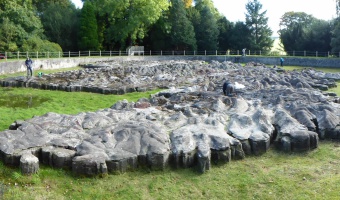
1979 – Great Polish Map of Scotland

The "Great Polish Map of Scotland" is a 50 x 40 m concrete terrain model of Scotland. It was built by a Polish sergeant who stationed in Scotland during WWII and ended up living there. It is claimed to be the world's largest terrain model, although the Chinese built a 900 x 700 m model in 1999. Source: Atlas Obscura. Great Polish Map of Scotland.

Added by: Pierre Dragicevic, sent by: Benjamin Bach. Category: Physical model  Tags: cartographic, scotland, terrain model, walkable


2003 – Pattern Recognition in a Bucket

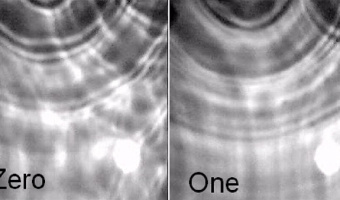
Chrisantha Fernando and Sampsa Sojakka from the University of Sussex published a paper where they demonstrate that a bucket of water can carry out complex, parallel computations, and can even do simple speech recognition. Their setup called "liquid brain" consists in a transparent water tank suspended over an overhead projector and four LEGO motors. Input values are sent to the motors which vibrate the water. A camera then reads the watter ripples and sends the data to a simple perceptron. The […]


2015 – Jller: A Robot Rearranges Pebbles by Geologic Age

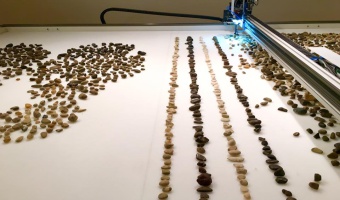
Jller is a machine created by German artist Benjamin Maus and Czech artist Prokop Bartoníček that sorts pebbles from the German river Jller by their geologic age. To do this, Jller first analyzes an image of the stone it selects, extracting information like dominant color, color composition, lines, layers, patterns, grain, and surface texture. The machine then places the stones in alignment of age and type by sucking them into an industrial vacuum gripper and dropping them in the correct […]

Added by: Pierre Dragicevic, sent by: Alice Thudt. Category: Passive physical visualization  Tags: age, geology, pebbles, rearrangement, robot


2016 – Housing Prices Ripping San Francisco Apart

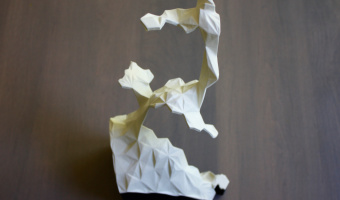
This data sculpture depicts a map of housing prices in San Francisco. It’s a map of the city, torn at the seams. The height of each area represents the average price per square foot for recent home sales. Where neighboring areas are close in value they are connected, but if neighboring areas are too far from each other I allow them to split, tearing the city along its most severe economic divides. Sources: Doug McCune (2016) Sculpture of Housing Prices Ripping San Francisco Apart Abigail Cain […]


2016 – Motus Forma: People's Motions in a Shared Space

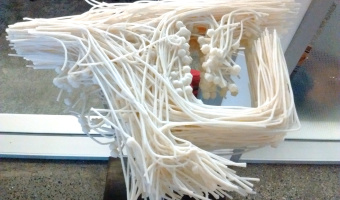
Motus Forma is a data sculpture by Brian Allen and Stephanie Smith that aggregates 10 hours of people movements in the lobby space at Pier 9. The 1300+ motion paths are piled up according to time. Sources: Autodesk (2016) Motus Forma Instructables (2016) Motus Forma Photo by Pierre Dragicevic Related: Also see our other entries on temporal data.

Added by: Pierre Dragicevic. Category: Passive physical visualization  Tags: 3d printing, data sculpture, temporal data