Tag: Pierre Dragicevic

30000 BC – The Very First Sculptures

While data sculptures date back from the 1990s, the very first sculptures were Venus figurines: A Venus figurine is any Upper Paleolithic statuette portraying a woman with exaggerated physical features. The oldest ones are about 35,000 years old. Also see V.S. Ramachandran on the peak shift principle in art. Sources: Wikipedia article on Venus figurines. Left image from ancient-origins.net

Added by: Pierre Dragicevic. Category: Physical model  Tags: archaeology, sculptures, venus figurine, women


1995 – San Diego TeleManufacturing Facility

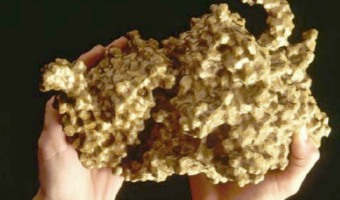
In 1995, Mike Bailey from the San Diego Supercomputer Center created the SDSC TeleManufacturing Facility to help scientists visualize their data in physical form. In 1997, the facility produced one of the first digitally-fabricated molecular models using laminated object manufacturing. The biochemists involved in the project got insights that they were not able to get from the on-screen 3D models, and concluded that: modern physical models are important tools that significantly extend the […]


2009 – Federal Budget Explained with 10,000 Pennies

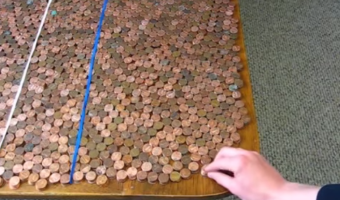
Political Math (formerly called 10000Pennies on the Youtube channel) is a blogger who criticizes the US policy using stats and low-tech physical visualizations. His first 2009 video titled "Obama Budget Cuts Visualization" (left image) got 1.7 million views. Coins, but also bills, water or whisky stand for units of money or jobs. A video often ends with a dramatic action where the blogger cuts a penny in two, overturns a gallon container, spills hundreds of coins from a table, freezes water, or […]

Added by: Pierre Dragicevic. Category: Passive physical visualization  Tags: budget, employment, politics, storytelling


2010 – Cookbook Arranges Ingredients into Physical Visualizations

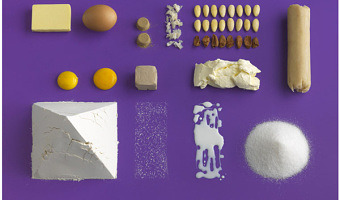
In Sweden, IKEA gives away baking books where ingredients are arranged into physical visualizations. The photos are by Karl Kleiner. This idea is reminiscent of Ursus Wehrli's art projects. Sources: Niels-Peter Foppen (2010) Hembakat är Bäst. Via Iohanna Nicenboim's pinterest. Images from notcot.com.

Added by: Pierre Dragicevic. Category: Passive physical visualization  Tags: cookbook, food, ingredients, rearrangement, recipes


2013 – Population Density Emerging from Walls

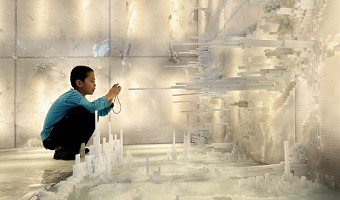
Two Yale architects created a room-sized physical visualization of world population density folded into itself: Hsiang and Mendis then turned that spatial visualization into a physical installation at the 2011 Chengdu Biennale in China. They modeled the population distribution of the entire world in a kind of inverted map that visitors could walk into, inside a 10-by-10-by-10 foot room, with North America on the ceiling, Asia on one wall, Africa on another (see also the little boy in the above […]

Added by: Pierre Dragicevic. Category: Passive physical visualization  Tags: cartographic, data sculpture, population density, walkable


2014 – Silver Ring Shaped by DNA Profile

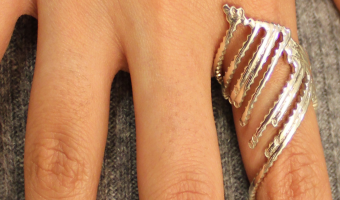
PhD student Alireza Rezaeian designed a silver ring whose texture and shape is uniquely determined by the wearer's DNA profile. His article explains how data is mapped to physical form in a way that balances between legibility and aesthetics. Right image: bracelet-sized prototype. Source: Rezaeian, Alireza & Donovan, Jared (2014) Design of a tangible data visualization. Related: Also see our other entries on data jewellery.

Added by: Pierre Dragicevic, sent by: Simon Stusak. Category: Passive physical visualization  Tags: 3d printing, data jewellery, dna, genetics


2015 – Sicherheit: Switzerland's Money in Bar Charts

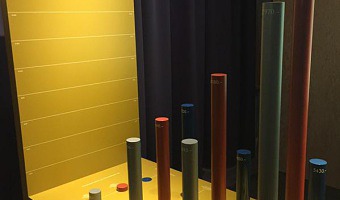
This physical bar chart titled Sicherheit (Security) is part of the exhibition Geld – Jenseits von Gut und Böse (Money - Beyond Good and Evil) at the Stapferhaus in Lenzburg, Switzerland. It shows where Switzerland has its money from, where it spends it and how high Switzerland's debt is. Sources: Photo and most of the text above by Peter Gassner. Author of the piece currently unknown, as several studios have been involved in the making of the exhibition.

Added by: Pierre Dragicevic, sent by: Peter Gassner. Category: Passive physical visualization  Tags: data sculpture, debt, money, switzerland


2015 – Touching Air: Necklace Shows Air Pollution

This necklace made by Stefanie Posavec and Miriam Quick shows one week of air quality data measured in the city of Sheffield. Each segment is a period of 6 hours, and its appearance conveys the concentration of particulate matter during that period of time. A low concentration yields a small, round, green segment. A high concentration yields a large, spiky, red segment. Sources: Stefanie Posavec (2015) Air Transformed: Better with Data Society Commission. Photos by Stefanie Posavec. Related: […]

Added by: Pierre Dragicevic, sent by: Maarten Lambrechts & Fanny Chevalier. Category: Passive physical visualization  Tags: air pollution, air quality, data jewellery, data sculpture, digital fabrication


2015 – Solid Model of Stellar Winds

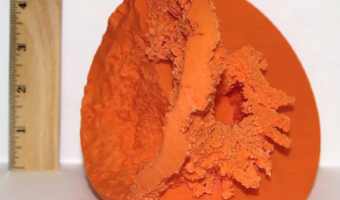
Scientists keep using solid models to help them better understand complex 3D data (here, an astrophysical simulation): They say this provides even more insight into what’s going on. “The ability to hold and inspect the 3-D printed models provides a new perspective on the WWIR’s geometry and an improved sense of the scale of the different structures,” they say. In particular, they say the model allows them to appreciate just how large the shockwave is compared to the stars and the distance […]

Added by: Pierre Dragicevic, sent by: Jean-Daniel Fekete. Category: Physical model  Tags: 3d printing, astronomy, digital fabrication, science, simulation


2015 – Physical Customer Satisfaction Survey

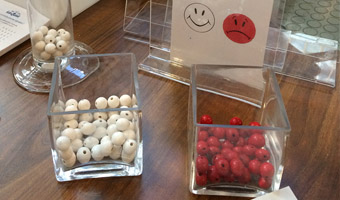
Participatory physical bar charts at the exit of the Antell cafeteria at the University of Helsinki. White beads represent statisfied customers, red beads are unsatisfied ones. Source: Antell. Photo by Luana Micallef. Related: Also see similar contraptions by Hans Haacke (1970), Lucy Kimbell (2006), and Jennifer Payne (2014).

Added by: Pierre Dragicevic. Category: Passive physical visualization  Tags: bar chart, customer satisfaction, participatory