Tag: Enabling Technology

1200 – Pop-Up and Movable Books

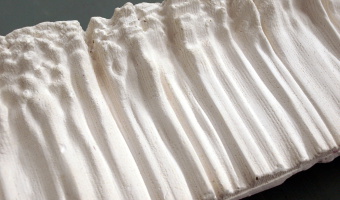
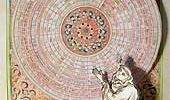
While gatefold mechanisms were already used in the 1100s, one of the first movable paper mechanisms was a volvelle created by Benedictine Monk Matthew Paris to calculate the dates of Christian holidays in his book Chronica Majorca (1236-1253, see left image above). Volvelles are paper discs or rings placed on top of each other that rotate around a string or rivet. Many other types of paper mechanisms have been invented since then, such as flaps, which were used in anatomy books starting from […]

Added by: Pierre Dragicevic, sent by: Benjamin Bach. Category: Enabling technology  Tags: anatomy, book, mechanical interaction, paper, pop-up

1897 – Stop Motion Animation

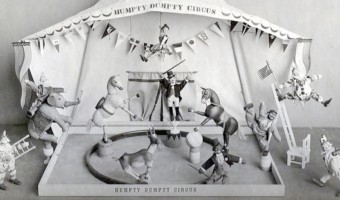
Stop motion animation is the frame-by-frame capture of (generally) inanimate objects which are manipulated by increments in order to produce the illusion of motion. It was first used in movies to produce magical effects. The first movie to use this technique was The Humpty Dumpty Circus (1897), where a toy circus of acrobats and animals comes to life (left image). With modern 3D computer graphics, stop motion animation has become largely obsolete, but remains occasionally used. A particularly […]

Added by: Pierre Dragicevic. Category: Enabling technology  Tags: stop motion animation


1970 – Byron's Bender

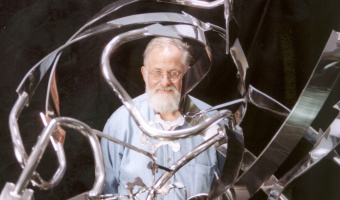
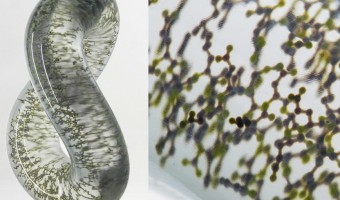
In the early 1970's, crystallographer Byron Rubin invented a tool that bends wires to make proteins models. The tool was popular until the 1990s. Byron Rubin became an artist who builds large-scale molecular sculptures. Eric Martz and Eric Francoeur explain how such physical models yielded important scientific insights: An example illustrating the importance of models from Byron's Bender occurred at a scientific meeting in the mid 1970's. At this time, less than two dozen protein structures had […]

Added by: Pierre Dragicevic. Category: Enabling technology  Tags: chemistry, molecule, protein, science, steel


1977 – Graphical Waterfall

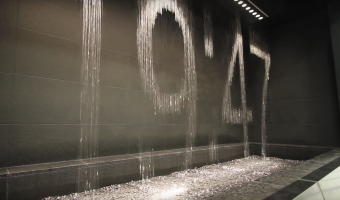
   A graphical waterfall is a display where images are formed by water droplets falling from computer-controlled nozzles. It was invented in 1977 by Stephen Pevnick, an American artist. Graphical waterfalls can be used with regular lighting (as on the left video) or with a stroboscope (as on the right video), depending on the desired effect. It is unclear whether such devices have been already used to display data. Sources: Pevnick Design (2018), Invention of […]

Added by: Pierre Dragicevic. Category: Enabling technology  Tags: display, water


2000 – A Shape Display Appears in a Movie

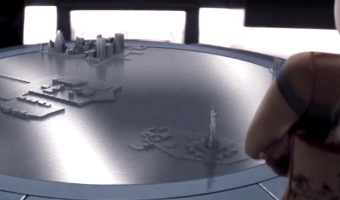
An imaginary ultra high-resolution 2.5D shape display appears in the 2000 movie X-Men. The rendering and animations are visually quite appealing. Notice how impossible overhangs appear at 0:27 (the bridge) and 0:33 (the torch of the Statue of Liberty). Source: 20th Century Fox (2000) X-Men. Related: This movie scene has prompted a company to design and build an actuated solid terrain model for military customers, see our entry 2004 – XenoVision Mark III. Also see our entry 2009 – Leithinger’s […]

Added by: Pierre Dragicevic. Category: Enabling technology  Tags: cartographic, movie, pop culture, sci-fi, shape display


2013 – Programmable Matter Stars in a Movie

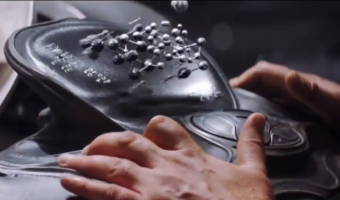
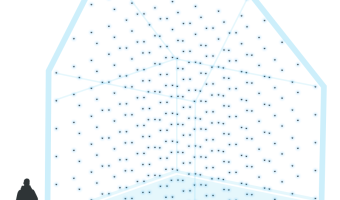
Programmable matter with levitation capabilities is a key visual element in the 2013 movie Man of Steel. The (slowed down) segment above reveals what appears to be a 3D node-link diagram. This display technology is employed by an advanced civilization on Krypton and is referred to as Liquid Geometry or Liquid Geo by the movie team. Visual effects supervisor Dan Lemmon explains that it consists in: a bunch of silver beads that are suspended through a magnetic field, and the machine is able to […]

Added by: Pierre Dragicevic. Category: Enabling technology  Tags: movie, network, pop culture, programmable matter, sci-fi


2015 – Create your own Sound Sculpture

This Rhinoscript/Grasshopper procedure creates a 3D printing of an audio file by translating the waves into 3D curves instead of displaying them in 2D, thus elabling the user to "feel" the sound. Source: 3D Sound representation Related: Also see our other entries on sound.

Added by: Jean Vanderdonckt. Category: Enabling technology  Tags: sound, sound sculpture


2018 – Multimaterial Printing of Volumetric Scientific Visualizations

Researchers from MIT Media Lab and Harvard University have developed a method for accurately physicalizing scientific visualizations using multimaterial 3D printers: To fabricate an item on conventional 3D printers, one must make calculations regarding the object’s digital description, and then convert the resulting numeric description to geometric shapes which can be used to 3D print it. But the research team has developed a new technique to 3D print multimaterial data sets as physical […]

Added by: Pierre Dragicevic, sent by: Arnold Platon. Category: Enabling technology  Tags: 3d printing, multimaterial


2033 – Cetonia: Drone Swarm Visualizations

As part of the VIS'14 Workshop Death of the Desktop, infovis researcher Wesley Willett imagines how nano drone swarms may be used in 2033 both to capture and visualize data directly in the real world: At barely 1.5 centimeters across, each Cetonia scarab is a marvel of precision engineering. Designed from the ground up for agile flight, their integrated hydrogen chambers and a high-efficiency hover mode permit 15+ minutes of air time between charges. The hueSHIFT carapace is capable of […]

Added by: Pierre Dragicevic. Category: Enabling technology  Tags: future, nano drones


2060 – Programmable Matter

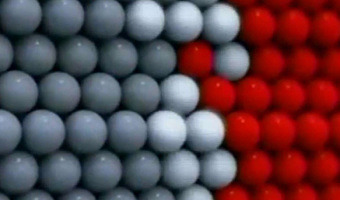
In 1965 Ivan Sutherland already mentioned programmable matter as the ultimate computer display: The ultimate display would, of course, be a room within which the computer can control the existence of matter. A chair displayed in such a room would be good enough to sit in. Handcuffs displayed in such a room would be confining, and a bullet displayed in such a room would be fatal. With appropriate programming such a display could literally be the Wonderland into which Alice walked. Several […]

Added by: Pierre Dragicevic. Category: Enabling technology  Tags: claytronics, future, programmable matter, radical atoms