Before the earliest unambiguous numbers in Mesopotamia, there are earlier hints of prehistoric numbers. One is a 25,000-year-old bone from Ishango, a site on a river that flows into Lake Mwitanzige, part of the so-called headwaters of the Nile. This artifact bears three rows of marks that are divided into groups by wider spacing. The groups on the first row suggest the prime numbers between ten and twenty in ascending order; those of the second row suggest adding and subtracting one from ten […]
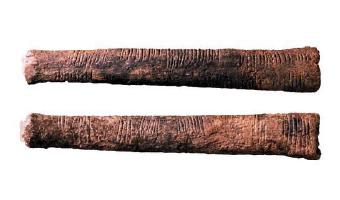
Before the earliest unambiguous numbers in Mesopotamia, there are earlier hints of prehistoric numbers. One is a 25,000-year-old bone from Ishango, a site on a river that flows into Lake Mwitanzige, part of the so-called headwaters of the Nile. This artifact bears three rows of marks that are divided into groups by wider spacing. The groups on the first row suggest the prime numbers between ten and twenty in ascending order; those of the second row suggest adding and subtracting one from ten and twenty, and those of the third row suggests halving and doubling, but inconsistently. These groupings seem unlikely to have been produced by chance, and scholars have speculated that they show the prehistoric development of complex mathematical concepts. However, as notations, the marks are unbundled and thus cumbersome, a trait that is difficult to reconcile with the notion they represent complex mathematical concepts. The artifact also has a piece of quartz affixed to one end, suggesting it may have been an engraving tool. The marks on a second bone from the same site are not mathematically interesting. This evidence is ultimately inconclusive for prehistoric numbers.
Sources:
Overmann, K.A. (2025). The Ishango Bone Cultural Number Systems. Interdisciplinary Contributions to Archaeology. Springer, Cham. Wikipedia Ishango Bone Wikipedia Tally Stick Related: Also see our other entries on archaeological artefacts.