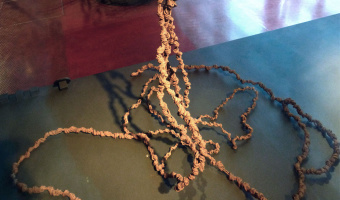
Tag: Passive Physical Visualization

1890 – Polynesian Genealogical Instrument

This artefact from the Marquesas Islands (French Polynesia) served as a memory aid for reciting genealogies during ceremonies. Each thread, made of woven coconut fiber, is a genealogical line and each knot is a generation. The genealogy goes back to the mythical origins of Earth, materialized by the oblong ball on top, made of wood (see left image). The date of the artefact is unknown. It was collected by Alphonse Long, French navy physician, while he was on duty in the Marquesas Islands […]

Added by: Pierre Dragicevic. Category: Passive physical visualization  Tags: anthropology, genealogy


1973 – Mazamet Ville Morte

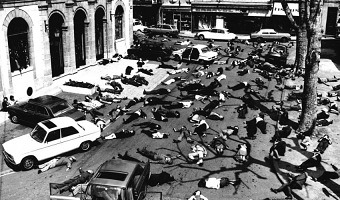
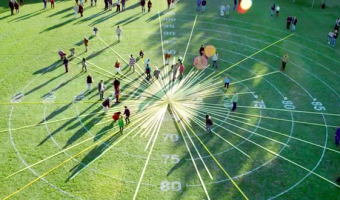
In 1973, the French town of Mazamet had a population that closely matched the nationwide number of motor vehicule deaths across the previous year. A TV reporter decided to show all inhabitants lying on the floor to symbolize these deaths. Source: Marieaunet (2010) 1973 Mazamet ville morte.

Added by: Pierre Dragicevic, sent by: Charles Nepote. Category: Passive physical visualization  Tags: deaths, participatory, people, rearrangement, single-datum


2009 – How Much Sugar do you Consume?

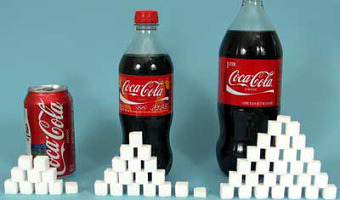
Nutrition labels are often difficult to apprehend: when you drink a can of coke, you consume 39g of sugar, but how much is that? In order to increase consumer's awareness of how much sugar they ingest when eating and drinking, several campains have used a physical visualization using actual sugar cubes and sugar grains to represent the sugar content in food. Many examples can be found online (search for "sugar stacks" and "rethink your drink"). It is unclear when these representations started. […]

Added by: Fanny Chevalier. Category: Passive physical visualization  Tags: concrete scale, food, single-datum, sugar


2011 – Sleep Patterns

Laurie Frick's Pokey Red is a physical visualization of sleep data over a month. Frick makes an interesting use of the physical support: in her visualization, periods of sleep of a lesser interest (light sleep) are folded up, giving more importance to the periods of quality sleep (coloured rectangles), while remaining integral part of the visualization. "Pokey Red" 12 in x 12 in, cut paper, watercolor and ink. Based on a month of sleep data, with the light sleep (aka trash sleep) periods folded […]

Added by: Fanny Chevalier. Category: Passive physical visualization  Tags: paper, quantified slef, sleep, temporal data


2012 – Bit Planner - LEGO calendar

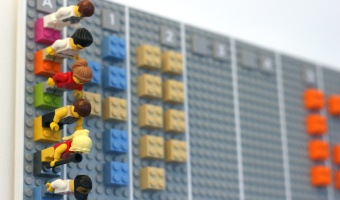
Vitamins studio created The Bit Planner, an elegant wall mounted time and resource planner made entirely of Lego bricks. In this tangible calendar, each gray row represents a month, and each gray rectangle represents a week, and everyone in the group has their own line in the calendar (see left image). Projects are associated to different colors, and each LEGO block corresponds to half a day spent working on a project. While entirely tangible, the Bit Planner can be synched with an online, […]


2013 – Doug McCune's Physical Maps

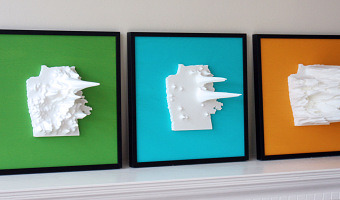
Doug McCune is a programmer turned artist, and he is obsessed with maps. In 2013, he got bored with screens and started to build physical thematic maps. He specializes in turning "horrible data" such as murders and natural disasters into beautiful objects. Above on the left is an artwork titled "stalagmite crime" that shows elevation maps of crime rates in San Francisco: narcotics-related crimes (green), prostitution (blue) and vehicle theft (orange). Sources: Doug McCune (2013) Physical Maps – […]

Added by: Pierre Dragicevic. Category: Passive physical visualization  Tags: 3d printing, cartographic, cartography, digital fabrication, maps


2015 – Canadian Federal Election Explained with LEGOs

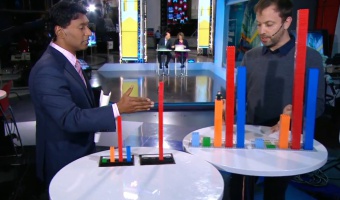
On Canadian national news, Toronto-based artist and organiser Dave Meslin used LEGO bricks to illustrate the results of the 2015 federal election. He shows election results based on a first-past-the-post system, and compares them to a representation illustrating what results would look like if based on proportional representation. Source: CBC News (2015) If Canada had proportional representation: Dave Meslin shows with Lego.

Added by: Jennifer Payne. Category: Passive physical visualization  Tags: LEGO, politics, storytelling


2015 – Dan Gilbert's TV Ads

The famous psychology professor Dan Gilbert made a series of TV commercials for the insurance company Prudential, together with Ray Del Savio from Droga5 and Colin McConnell from Prudential. These TV commercials make a clever use of participatory physical visualizations to demonstrate and explain human biases in financial planning. Ribbon Experiment (left image): Dan Gilbert asks bystanders to estimate how much money they will need to retire. He then gives each of them a ribbon and asks them to […]

Added by: Pierre Dragicevic. Category: Passive physical visualization  Tags: participatory, storytelling, walkable


2015 – 3D Paper Model of Shrinking Aral Sea

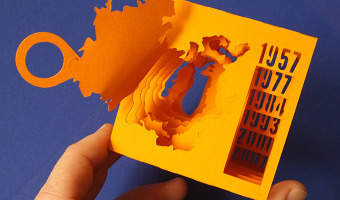
The Aral Sea in Uzbekistan, formerly one of the largest lakes in the world, has been drying up since the 1960s and is currently 10% its original size. Peter Vojtek made a 3-D paper model that shows the shrinkage — from 1957 on top, down to 2007. Each layer represents the surface outline during the corresponding year on the right. Vojtek also provides his paper template in case you want to fashion your own box. Sources: FlowingData Peter Vojtek (2015) 3D Paper Model of Shrinking Aral Sea.

Added by: Fanny Chevalier. Category: Passive physical visualization  Tags: cartographic, paper, temporal visualization


2015 – Multivariate Beer

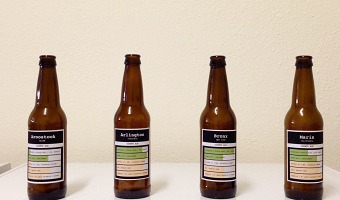
Nathan Yau from flowingdata brewed four different types of beer based on county demographics. For example, he mapped population density to the total amount of hops, and race percentages to the type of hops used. He describes the process in detail on his web site, with R source code. The idea is reminiscent of Rohit Khot's TastyBeats shown at the CHI '14 conference, an installation that creates personalized energy drinks based on heart beat data. Sources: Nathan Yau (2015) Brewing Multivariate […]

Added by: Pierre Dragicevic. Category: Passive physical visualization  Tags: beer, data cuisine, demographics, food