Tag: Passive Physical Visualization

1940s – Stedman's 3D Periodic Table

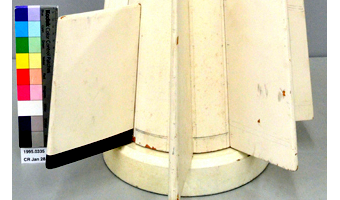
Dr. Don Stedman from the National Research Council Canada designed this 3-D periodic table in the 1940s. Stedman considered many factors and characteristics of the elements as he designed his models. While in this model all the usual groups of elements are found, changes from one group to another are also represented, and their origins are more easily understood. Stedman believed that his model gave more insight into “the orderly development and classification of the elements.” Source: Canada […]

Added by: Devon Elliott. Category: Passive physical visualization  Tags: chemistry, periodic table, science


1995 – Loren Madsen's Early Data Sculptures

Californian artist Loren Madsen has been making data sculptures since 1995 and still continues today. CPI / Cost of Living (left image) is the first of his series: A lamination is one year. Vertical axis is the Consumer Price Index (CPI) for food; the horizontal axis is the CPI for gasoline + electricity. The rising center line is the CPI for housing. The 'snout' is the 1960's when housing and food were cheap. The bulge above the snout is 1973---OPEC, gasoline lines, etc. Thereafter the cost of […]

Added by: Loren Madsen & Pierre Dragicevic. Category: Passive physical visualization  Tags: art, CPI, data, data sculpture, housing, income, information


2010 – Retweet Ripples

Interpreting tweets as droplets on an imaginary fluid surface, Karsten Schmidt and his colleagues created a 3D printed abstract visualization of tweets and their retweets forming ripple patterns. The visualization is created by first executing a Twitter search (here: "Justin Bieber") to create the initial droplets shown in the center of each ring. For each search result they then recursively executed secondary Twitter searches for retweets to create more droplets and used these to form […]

Added by: Karsten Schmidt. Category: Passive physical visualization  Tags: 3D print, cluster, network, twitter


2011 – Manually Animated Graph of Scientific Data

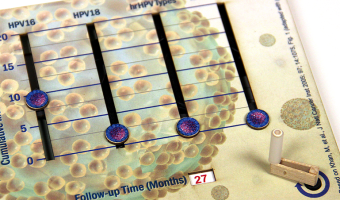
Philadelphia-based multi-discipline artist Bradley Litwin built this physical chart that can be animated by turning a crank. It is the only manually-animated physical visualization we know of so far. It was commissionned by a pharmaceutical company, intended as an educational device for distributing to doctors. Bradley was kind enough to send us an image of the insides of the original prototype, "not quite as pretty as the final product", he says. His explanation: As the crank is turned, a […]

Added by: Yvonne Jansen & Pierre Dragicevic. Category: Passive physical visualization  Tags: animation, mechanical interaction, science


2013 – Examined Life: Giving Shape to Activities

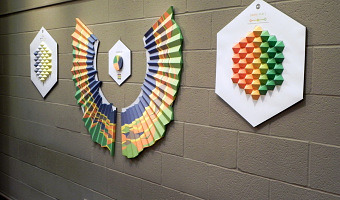
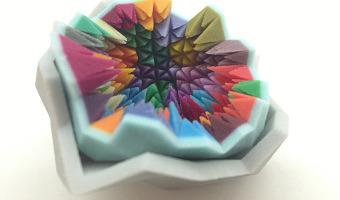
Designer Alex Getty logged his daily activities for 40 days and turned them into data sculptures that look like colored paper origami. Source: Alex Getty (2013) The Examined Life

Added by: Pierre Dragicevic. Category: Passive physical visualization  Tags: activity data, origami, paper, self-logging


2013 – Loci: 3D Printed Sculptures of Your Flights

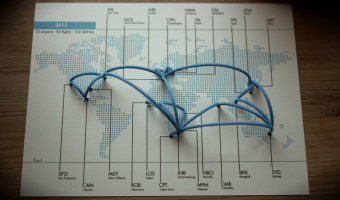
Loci by Andrew Spitz lets you easily create physical 3d arc diagrams based on your past flights, and may be soon be available through an iphone app. Source: Andrew Spitz (2013) Loci - 3D Printed Sculptures of Your Flights.


2013 – Turning Facebook Connections into Data Sculptures

An application created by SOFTlab and The Creators Project lets you turn your facebook social network into a beautiful crystal-like data sculpture. Sources: Kree8tiv via iohannan's pinterest. See the page on shapeways.

Added by: Pierre Dragicevic. Category: Passive physical visualization  Tags: data sculpture, remote fabrication, social network


2013 – A Snow Chart of Mobility in Science

A barchar made out of snow. Each bar is a percent of scientist after PhD that changed their university after thesis defence. Source: Przemyslaw Biecek (2013) SmarterPoland.

Added by: Przemyslaw Biecek. Category: Passive physical visualization  Tags: bar chart, snow


2014 – Data Strings: Physical Parallel Coordinates

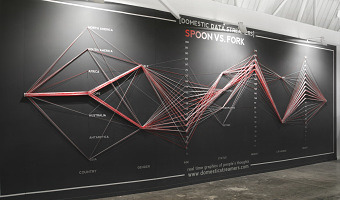
During the SWAB International Contemporary Art Fair, the group of developers Domestic Data Streamers had the audience create a physical parallel coordinates visualization based on their demographic profile (social status, weight, etc.) and by answering a meaningless question on whether they choose a spoon or a fork. Source: Domestic Data Streamers (2014) Data Strings. They have a range of other interesting physical visualization projects on their Web page.

Added by: Pierre Dragicevic. Category: Passive physical visualization  Tags: demographic, nails, parallel coordinates, participatory, threads