Tag: Passive Physical Visualization

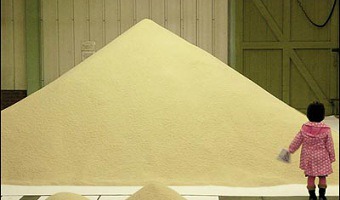
2004 – Of All the People in All the World: Stats with Rice

Since around 2004 the British group of artists Stan’s Cafe is creating data landscapes all over the world by mapping each grain of rice to a person in order to convey various statistics such as city populations or deaths in the holocaust. The size and theme of the show change depending on the location. The largest one involved 104 tons of rice. Rice is weighted manually in small quantities and manually poured over piles. This labor-intensive process is part of the show. Sources: Stan's […]


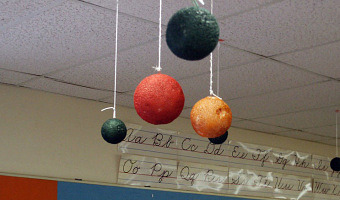
2006 – RoomQuake: Earthquake Visualization for the Classroom

Styrofoam balls hung from classroom ceiling representing the epicenters (location), magnitudes (diameter and color), and depths (length of the string) of a series of simulated earthquakes in a fifth grade classroom. Source: Tom Moher (2006) Embedded Phenomena: Supporting Science Learning with Classroom-sized Distributed Simulations.

Added by: Pierre Dragicevic, sent by: Tom Moher. Category: Passive physical visualization  Tags: earthquake, education, hand-made, styrofoam, walkable


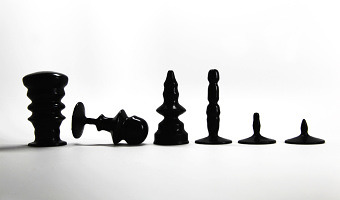
2012 – Grand Old Party: Political Satire

American designer Matthew Epler shows how to build physical visualizations out of silicone using 3D printing and mold casting. He also shows how to use them to make political statements. Source: Matthew Epler (2012) Grand Old Party (video here).

Added by: Pierre Dragicevic, sent by: Fanny Chevalier. Category: Passive physical visualization  Tags: 3d printing, adult toy, digital fabrication, extruded 2d, moulding, opinion polls, politics, satire, silicone


2012 – Data Cuisine

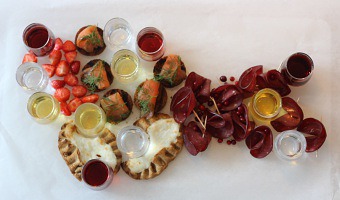
The left image is a map that shows the differences in alcohol consumption across Finland, as well as typical local food. The right image shows the number of immigrants in Finland by nationality (rice for the Chinese, salmon for the Swedish). Many other examples of edible physical visualizations can be found on the Data Cuisine web site. Data Cuisine is a series of workshops organized by Moritz Stefaner and prozessagenten. Seven workshops took place so far, the first one was in Helsinki in 2012. […]

Added by: Pierre Dragicevic, sent by: Romain DiVozzo. Category: Passive physical visualization  Tags: cartographic, data cuisine, edible, food, world stats


2013 – Data Sculpture of Chicken Inbreeding

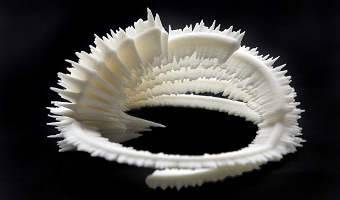
Ryo Sakai and Jan Aerts from the Bioinformatics/Data Visualization Lab at KULeuven created a data-driven sculpture representing inbreeding in a particular chicken. Each loop in the sculpture represents a chromosome. On the outside is a histogram of the heterozygosity of the DNA; the inside a histogram of the homozygosity in that region. These sculptures are part of the Cosmopolitan Chicken Project, and have been presented at the Art Biennale in Venice. Source: Text and images from Jan Aerts.

Added by: Pierre Dragicevic, sent by: Jan Aerts. Category: Passive physical visualization  Tags: 3d printing, bio-engineering, digital fabrication, dna, science


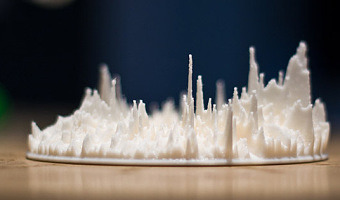
2013 – Very Pointy Elevation Map

Toronto-based startup DataAppeal, which develops Web apps for 3D geo-spatial data visualization, created this very pointy stalagmite-looking elevation map of GTA Transit volume in Toronto. Sources: Andy Kirk (2013) 3D Printing Capabilility via DataAppeal Maps. Candice So (2013) Data visualizations go from flat to 3D.


2013 – Robot Arranges 8,000 Nails Into a Data Sculpture of the Wind

Student and interaction designer Charles Aweida used a foam board, a robot and lots of nails to build a physical visualization of a wind simulation. Sources: Charles Aweida (2013) An exploration in art + robotics representing wind through digital fabrication and the tangible. Via The Creator Project (2013) Data Sculpture Of The Wind Created Using A Robot And Lots Of Nails.

Added by: Pierre Dragicevic. Category: Passive physical visualization  Tags: digital fabrication, foam board, nails, robot, wind


2013 – Behavioral Landscapes

A mixed team of artists and scientists at Pennsylvania State University devised a method to visualize human behavior, personality and emotions as 3D probability density functions. They then produced solid models using CNC milling. Sources: Studio|Lab (2013) Behavioral Landscapes. Nilam Ram, Michael Coccia, David Conroy, Amy Lorek, Brian Orland, Aaron Pincus, Martin Sliwinski, and Denis Gerstorf (2013) Behavioral Landscapes and Change in Behavioral Landscapes: A Multiple Time-Scale Density […]

Added by: Pierre Dragicevic. Category: Passive physical visualization  Tags: behavior, personality, psychology


2014 – Data Crystals: Conglomerated World Stats

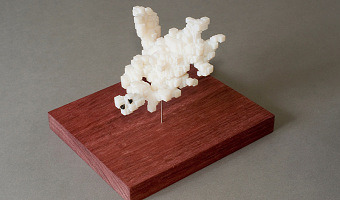
During his residency at Autodesk, artist Scott Kildall created crystal-looking data sculptures by turning world data such as city populations into small cubes laid out on an Earth globe, then running a force-directed algorithm that conglomerates them into a monolithic structure that can be 3D-printed. The image above shows the 2500 nuclear detonations in recorded history, two of which (the black dots) are the bombs dropped at Hiroshima and Nagasaki, the only ones used as weapons. Source: Scott […]


2014 – 888,246 Ceramic Poppies to Commemorate Fallen Soldiers in WW1

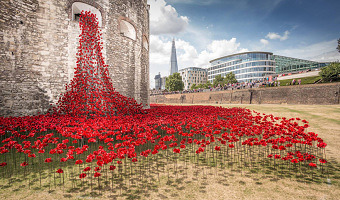
Don't miss the major art installation Blood Swept Lands and Seas of Red at the Tower of London, marking one hundred years since the first full day of Britain's involvement in the First World War. Created by ceramic artist Paul Cummins, with setting by stage designer Tom Piper, 888,246 ceramic poppies will progressively fill the Tower's famous moat over the summer. Each poppy represents a British military fatality during the war. The poppies will encircle the iconic landmark, creating not only a […]

Added by: Yvonne Jansen, sent by: Dan Hagon. Category: Passive physical visualization  Tags: ceramics, deaths, ephemeral, remembrance day, single-datum, walkable