Tag: Passive Physical Visualization

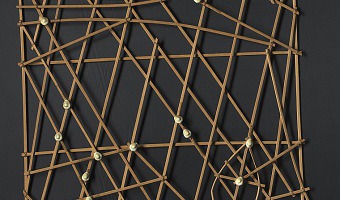
1862 – Marshall Islands Stick Charts

These physical visualizations show ocean swell patterns, and were built by native Micronesians from the Marshall Islands to facilitate canoe navigation. They were memorized before trips. The Western world remained unaware of the existence of these artifacts until 1862. The photo above is a stick chart from 1974. Straight sticks represent regular currents and waves, curved sticks represent ocean swells, and seashells represent atolls and islands. Sources: Wikipedia. Marshall Islands Stick […]

Added by: Pierre Dragicevic. Category: Passive physical visualization  Tags: anthropology, cartographic, marshall islands, stick chart


1871 – Thermodynamic Surfaces

A physical visualization by Scottish physicist James Maxwell (left), constructed over the course of about seven months, from November 1874 to July 1875, based on the descriptions of thermodynamics surfaces described in two 1873 papers by American engineer Willard Gibbs. The molded shape depicts the geometry of the three-dimensional thermodynamic surface of the various states of existence of water: solid, liquid, orgas, shown on Cartesian coordinates of the entropy (x), volume (y), and energy […]

Added by: Yvonne Jansen, sent by: Fanny Chevalier. Category: Passive physical visualization  Tags: clay, Maxwell, science, thermodynamics, Thompson


1947 – Dorothy Hodgkin's Electron Density Contours

Nobel prize winning crystallographer Dorothy Crowfoot Hodgkin created another physical visualization in the mid 1940's, showing part of the structure of penicillin. An original of this artifact is in the Oxford Museum of the History of Science. This technique recently inspired artist Angela Palmer for her glass portraits. Sources: Lachlan Michael and David Cranswicka (2008) Busting out of crystallography's Sisyphean prison: from pencil and paper to structure solving at the press of a button: […]

Added by: Pierre Dragicevic, sent by: Jean-Baptiste Labrune. Category: Passive physical visualization  Tags: chemistry, crystallography, penicillin, science, glass


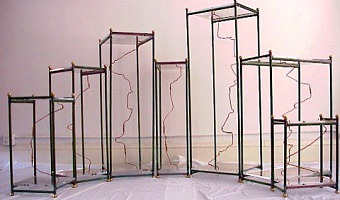
2003 – Time Pieces: Physical Space-Time Cubes

Artist Marilynn Taylor created seven three-dimensional maps (one for each day of the week) in which time is the z-axis and a copper wire shows how she moved across the city during the day. Source: Maryline Taylor (2003) Time pieces - Mapping the time and space of place (2003 version).

Added by: Pierre Dragicevic, sent by: Benjamin Bach. Category: Passive physical visualization  Tags: hand-made, temporal data


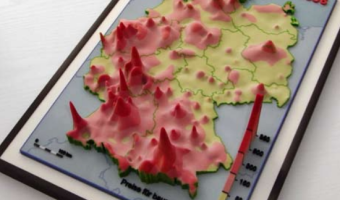
2010 – Thematic Maps of Germany

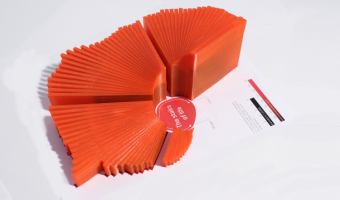
Physical cartographic visualizations built by geographer Wolf-Dieter Rase with a Z650 printer. Left: average prices for building lots in Germany in 2006. Middle: unemployment in Germany in 2006; The surface represent trends, the columns represent local deviations from the trends (magenta means higher, cyan means lower). Right: travel distance to airports. Source: Wolf-Dieter Rase (2012) Creating Physical 3D Maps Using Rapid Prototyping Techniques.

Added by: Pierre Dragicevic. Category: Passive physical visualization  Tags: 3d printing, cartographic


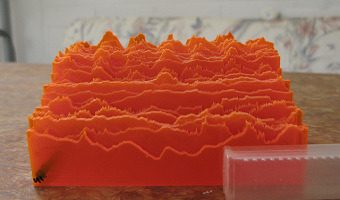
2012 – Matthijs Klip's Data Sculptures

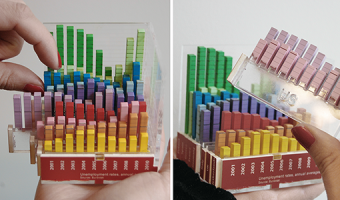
Left image: data sculpture by Dutch designer Matthijs Klip showing life expectancy of the Netherlands population. Each bar maps to an age; the bar's height represents life expectancy while its length represents the amount of people having that age. Right image: other designs by Matthijs Klip. Source: Matthijs Klip (2012) Physical Information Design.


2013 – Network of the German Civil Code

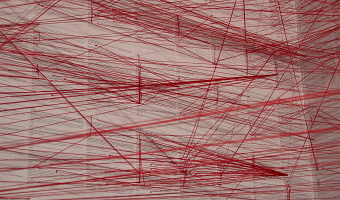
A room-filling visualization by Oliver Bieh-Zimmert (Visual Telling) that illustrates the patterns of references within the German civil code. Each red thread stands for a reference to another paragraph. Source: you can find more info and images on the visual telling website.

Added by: Yvonne Jansen, sent by: Pierre Dragicevic & Benjamin Bach. Category: Passive physical visualization  Tags: network, room-sized, walkable


2013 – Layered 2D Plots

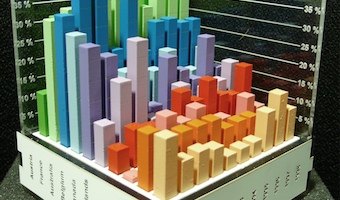
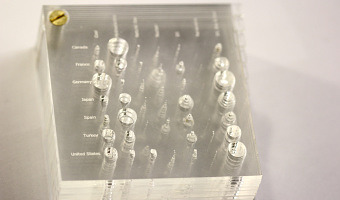
A series of stacked 2D plots showing changes in energy sources for different countries by PhD student Simon Stusak from University of Munich. All plots are cut from acrylic and hold together in one corner to facilitate alignment of the layers. The y-axis is mapped to countries, the x-axis to different energy sources, and the z-axis to time. Sources: Simon Stusak (2013) Physical Visualizations: An Exploration. Simon Stusak, Aurélien Tabard and Andreas Butz (2013) Can Physical Visualizations […]

Added by: Yvonne Jansen, sent by: Pierre Dragicevic. Category: Passive physical visualization  Tags: lasercut, rearrangeable, stacked 2D


2013 – NYC High School Dropouts

Ben Kauffman and Sam Brenner created this visualization as part of the ITP program at the NYU Tisch School of the Arts. It is a combination of a 3D-printed relief map of New York City with beads where each bead represents one school location. Each bead on top of the relief map is connected to a string below whose length indicates the number of students who dropped out of that school. Source: More pictures, a video and all the details on the project can be found on their project page.

Added by: Yvonne Jansen, sent by: Ben Kauffman. Category: Passive physical visualization  Tags: 3d printing, cartographic