Tag: Passive Physical Visualization

1957 – Proteine Visualizations

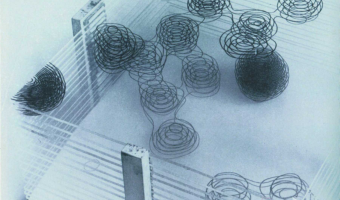
Left image: The very first physical model of a protein (myoglobin) built by crystallographer John Kendrew in 1957 using plasticine. The image is from a 1958 Nature article, for a more recent photo see here. In 1960 Kendrew completed a higher-resolution skeletal model known as the "forest of rods". The model was 2-meter wide, made of brass, and supported with 2,500 vertical rods, making it barely legible. Colored clips were attached to the rods to visualize electron density. See photos here and […]

Added by: Pierre Dragicevic. Category: Passive physical visualization  Tags: chemistry, hemoglobin, Perutz, proteine, science


2002 – Bathsheba Grossman's Crystal Engravings

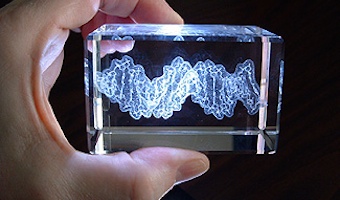
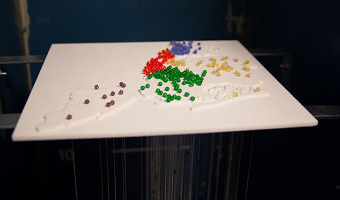
Artist Bathsheba Grossman has been 3D printing mathematical surfaces as early as 1997. In 2002 she started to use subsurface laser engraving to produce 3D physical visualizations of data from astronomy, biology, and physics. Left image: a piece of DNA molecule. Right image: a 3D map of our nearby stars. The artist explains to us: This medium excels at imaging less structural data such as disconnected volumes, non-compact point clouds, and the convoluted strands of proteins. It works by […]


2004 – Cylinder: Early Sound Sculpture

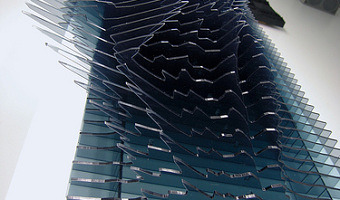
Cylinder by Andy Huntington and Drew Allan may be one of the first digitally-fabricated sound sculptures. Source: http://extraversion.co.uk/2003/cylinder/ Related: Also see our entry 2007 - Explosion of sound sculptures.

Added by: Pierre Dragicevic, sent by: Fanny Chevalier. Category: Passive physical visualization  Tags: 3d printing, digital fabrication, sound, sound sculpture, temporal data


2007 – Explosion of Sound Sculptures

In 2007-2008, sound became an endless source of inspiration for data sculptors. Examples include (images from left to right): Binaural by Daniel Widrig & Shajay Bhooshan (2007) Sound/Chair by Plummer Fernandez (2008) Sound Memory by Marius Watz (2008) Reflection by Andreas Nicolas Fischer & Benjamin Maus (2008) I Will Never Change by Us by Benga (2012) Microsonic Landscapes by Juan Manuel de J. Escalante (2012) The Shape of the Sound of the Shape of the Sound by Stephen Barrass (2012) […]

Added by: Pierre Dragicevic & Yvonne Jansen, sent by: Fanny Chevalier & Benjamin Bach. Category: Passive physical visualization  Tags: art, data sculpture, sound, sound sculpture, temporal data


2008 – Activity Logging with LEGO Bricks

A visualization and logging method for personal work activity. Every tower is a day of the week. A layer is one working hour, horizontally subdivided in four quarters of an hour. Different colors are different projects. The constant availability of this interface makes it easier to log personal activity data on-the-fly, before entering it in a PIM software (an automatic method involving computer vision is being considered). Source: Michael Hunger (2008) On LEGO Powered Time-Tracking. Blog post. […]


2009 – Mitchell Whitelaw's Weather Sculptures

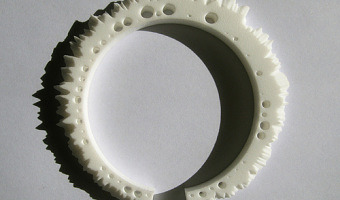
Weather data is another interesting choice for creating data jewelry. Above to the left is a bracelet created by Mitchell Whitelaw based on one year of weather data from Canberra. The right image shows a measuring cup made by the same artist, where each ring represents monthly average temperatures in Sydney over 150 years. Sources: Mitchell Whitelaw. Weather Bracelet (2009) Mitchell Whitelaw. Measuring Cup (2010)

Added by: Yvonne Jansen, sent by: Mitchell Whitelaw. Category: Passive physical visualization  Tags: 3d printing, data jewellery, digital fabrication, tableware, weather


2012 – Meshu.io: Data Jewellery you can Order Online

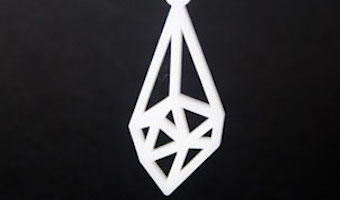
A company lets you enter in cities you've been to and generates a physical mesh to order as a necklace, earrings, or cufflinks. Source: http://meshu.io/

Added by: Pierre Dragicevic, sent by: Moritz Stefaner. Category: Passive physical visualization  Tags: data jewellery, personal data, remote fabrication, trips


2012 – Thesis LEGO Board

A design exploration of LEGO-based physical visualizations for project management by educational scientist Daniel K. Schneider. Sources: Daniel K. Schneider (2012) Lego-compatible thesis project board. Edutech Wiki. Daniel K. Schneider (2015) Poster presentation from the EIAH'15 conference (the paper, the actual poster)

Added by: Pierre Dragicevic. Category: Passive physical visualization  Tags: LEGO, manual update, project management, rearrangeable


2013 – Solid Statistics

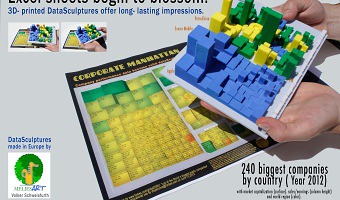
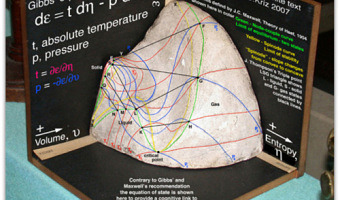
Left image: A 3D printed version of the "Forbes 2000" list showing the 240 largest companies, by Volker Schweisfurth. Market value is mapped to surface area, sales volume is mapped to volume, and the continent from which the company originates is mapped to color (America (blue), Europe (green), Asia (yellow)). The picture illustrates how a physical model of this 3D visualization gives a better impression of perspective than the printed perceptual cues in the original paper visualization. Right […]

Added by: Yvonne Jansen, sent by: Volker Schweisfurth. Category: Passive physical visualization  Tags: 3d printing, statistical data