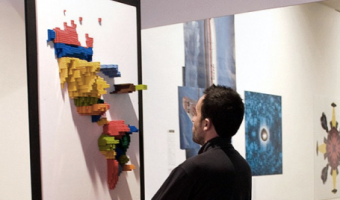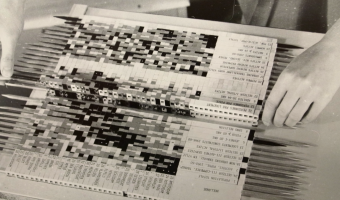
The reorderable matrix is a physical device developed in the mid 1960s by French cartographer Jacques Bertin for exploring and presenting tabular data. Bertin designed several reorderable physical matrices he called Dominos, each with a different size and visual encoding. The first three images above show a small, medium, and large version. A rod mechanism allowed unlocking either rows or columns for reordering. The dominos were part of a general method of “graphic information processing”, […]
The reorderable matrix is a physical device developed in the mid 1960s by French cartographer Jacques Bertin for exploring and presenting tabular data. Bertin designed several reorderable physical matrices he called Dominos, each with a different size and visual encoding. The first three images above show a small, medium, and large version. A rod mechanism allowed unlocking either rows or columns for reordering. The dominos were part of a general method of “graphic information processing”, extensively described by Bertin in a relatively poorly-known 1977 book. This method stems from his progressive realization that, while maps and charts are traditionally drawn once for all, “mobile images” can be freely manipulated to reveal patterns. Thus he recognized the importance of interactivity three decades before information visualization. Bertin physically implemented five types of “interactive” visualizations: the family of curves (line charts on transparent paper sheets that can be superimposed) the image file (stacked cards with a visual index) the collection of maps (rearrangeable small multiples) the collection of ordered tables (rearrangeable paper tables), and finally the reorderable matrix. For Bertin, the reorderable matrix was by far the most powerful tool. His method required that numerical data be collected on a paper table to start with. Then, values were converted into discrete steps, again on a paper table (7 to 11 different steps depending on the Domino version). Then, the physical matrix was assembled by choosing among a collection of physical cells that encode different ranges of values. Afterwards, the matrix was reordered to reveal patterns, which could take a long time. Finally, meaningful groups were identified and named. The result was then photographied or photocopied, and the final image was used as a figure in the scientific publication, enriched with a legend and caption. The first video (fourth image above) shows a reorderable matrix being used. The second video is an educational video explaing the method to a large audience (English subtitles are available). Bertin's method of data analysis, while time-consuming, remained popular for a while and underwent several computer adaptations. Sources: Jacques Bertin (1969) Graphique et mathématique : généralisation du traitement graphique de l'information. Jacques Bertin (1977) La graphique et le traitement graphique de l'information. Jacques Bertin (1981 translation). Graphics and Graphic Information Processing. Charles Perin, Pierre Dragicevic, and Jean-Daniel Fekete (2014) Revisiting Bertin Matrices: New Interactions for Crafting Tabular Visualizations. Serge Bonin (1998) Le développement de la graphique de 1967 à 1997. Gilles Palsky (2003) L'esprit des cartes, pp. 99-100. The first photo was taken during Jacques Bertin's 2005 interview by Jean-Daniel Fekete, Nathalie Henry and Jean-Baptiste Labrune. The second photo is from Archives Nationales. The third photo is from Bertin's book "la Graphique et le traitement graphique de l'information", captured from these slides by Torsten Möller. The two videos are 8-mm movies borrowed from the Archives Nationales and digitized by us. You can find photos of Jacques Bertin showing one of his matrices in the flickr photo set by Jean-Baptiste Labrune. Also see Jean-Daniel Fekete's interview on Jacques Bertin by Enrico Bertini, our interview by Data Stories where we demo a simplified version of Bertin's matrix made by Innar Liiv, and the Web page of Bertifier which has a comprehensive bibliography on the topic.