Tag: Physical Model

1500 – Plans-Reliefs

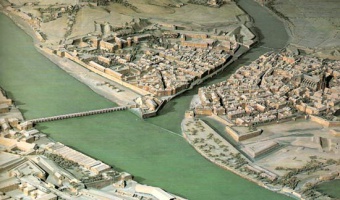
The first terrain/city models date back from the 16th century and were created for military purposes. Left image: a plan-relief of Bayonne, created by Sébastian Vauban (1633–1707), a famous fortification engineer of King Louis XIV. Right image: a plan-relief of Grenoble from 1848. These scale models were highly prized for the tactical advantage they brought, and they were also shown around for dissuasive purposes. “Il y a un relief de Namur dans les Tuileries, je vous demanderai d'avoir la […]

Added by: Pierre Dragicevic. Category: Physical model  Tags: cartographic, plan relief, terrain model, walkable

1900 – Crum Brown's Mathematical Surface

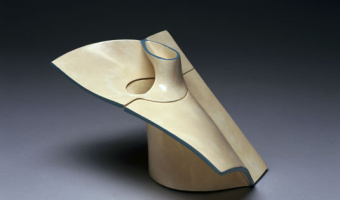
Model by Alexander Crum Brown (1838-1922) of a half-twist mathematical surface, featuring a non-Euclidean so-called Klein bottle, c. 1900. Sources: Photo from the Science Museum, London, textual description courtesy of Klaus Hentschel. For more, see Klaus Hentschel (2014): Visual Cultures in Science, Technology and Medicine, pp. 96ff. and pl. XIV.

Added by: Pierre Dragicevic, sent by: Klaus Hentschel. Category: Physical model  Tags: mathematics, science


1934 – Hayward's Moon Model

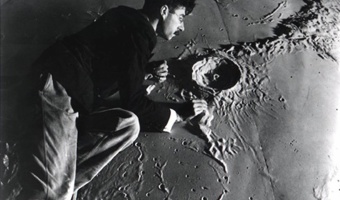
Illustrator and model-maker Roger Hayward (1899-1979) working on a model of the lunar surface for the Griffith Planetarium, 1934. Sources: Kevin Kidney (2009) Mr. Hayward's Moon Model. Photo from Keven Kidney's blog, textual description courtesy of Klaus Hentschel. For more, see Klaus Hentschel (2014): Visual Cultures in Science, Technology and Medicine, pp. 217-226.

Added by: Pierre Dragicevic, sent by: Klaus Hentschel. Category: Physical model  Tags: cartographic, globe, moon


1949 – Mississippi River Basin Model

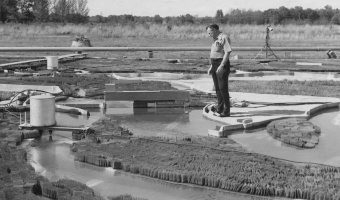
As a response to devastating floods of the Mississippi river in the early 1900s, the US Army Corps of Engineers built a large-scale hydraulic model of the entire river system. The model, 2.5 times the size of Disneyland, allowed them to design better flood control infrastructures and to eventually save millions of dollars. In 1973, the physical model ceased to be used and was replaced by computer models. Nevertheless, mathematical equations still cannot capture all the complexity of river […]

Added by: Pierre Dragicevic, sent by: Wesley Willett. Category: Physical model  Tags: cartographic, hydraulic, physical computation, terrain model, walkable, water


1979 – Great Polish Map of Scotland

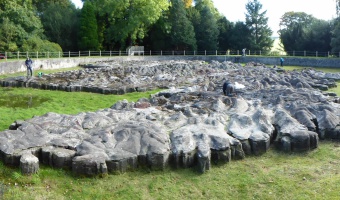
The "Great Polish Map of Scotland" is a 50 x 40 m concrete terrain model of Scotland. It was built by a Polish sergeant who stationed in Scotland during WWII and ended up living there. It is claimed to be the world's largest terrain model, although the Chinese built a 900 x 700 m model in 1999. Source: Atlas Obscura. Great Polish Map of Scotland.

Added by: Pierre Dragicevic, sent by: Benjamin Bach. Category: Physical model  Tags: cartographic, scotland, terrain model, walkable


2006 – Clebsch Cubic Surface

A 90 cm tall Clebsch bicubic surface hand made in resin and fiber. It includes all lines lying inside the surface. Also see our entry 1880 – Klein’s Mathematical Plaster Models for an earlier version made of plaster. Sources: Cayetano Ramirez. obratano.com (alternative website) Cayetano Ramirez (2006) Creation process for the transparent Clebsch surface.

Added by: Sergio Hernandez. Category: Physical model  Tags: mathemathics, science


2014 – Mount Saint Helens - Pre and Post Eruption

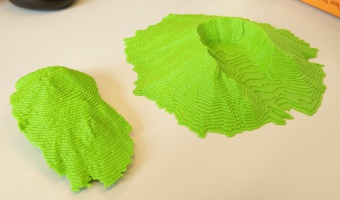
Mount Saint Helens is an active volcano located in the north-west of the United States. In an eruption in 1980, the upper section of the volcano was destroyed, reducing the peak's elevation from 2950 m to 2549 m. This two-part 3D printed model of Mount Saint Helens visualizes the dramatic change that occurred over a very short period of time. The digital data for 3D printing and the white and red model were prepared by Drew Thompson, the green model was printed by Jeppe Vestergaard. Sources: […]

Added by: Juernjakob Dugge. Category: Physical model  Tags: 3d printing, cartographic, temporal visualization


2015 – Rearrangeable Physical Map

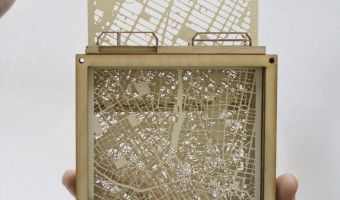
Andrew Chard, an award-winning graduate student in architecture at Oxford Brookes, created this multi-layered wooden map where layers can be individually pulled out and rearranged. According to the object's legend, this map shows different cities on top of each other so that people can compare their structure. There is not much information available online but Andrew explained to us by e-mail: It was so long ago that I wouldn’t be able to remember the scale or locations I am afraid. Apart from […]

Added by: Pierre Dragicevic, sent by: Carmen Hull. Category: Physical model  Tags: cartographic, laser-cut, rearrangeable


2018 – Solving the Shortest Route Problem with a 3D Printer

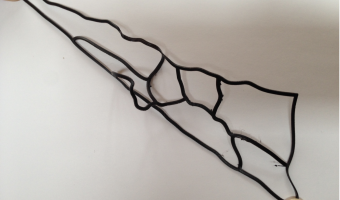
Christian Freksa, a professor of Cognitive Systems at the Department of Informatics at the University of Bremen, shows how a shortest route can be computed by 3D-printing the route network using flexible material, and then pulling apart the start and end nodes. The tight portion of the network immediately gives the shortest route. The right image shows an earlier version using strings. This idea was first proposed by mathematician George Minty in 1957, in a short letter to the editor of the […]

Added by: Pierre Dragicevic, sent by: Barbara Tversky. Category: Physical model  Tags: 3d printing, network, physical computation, route