Tag: Physical Model

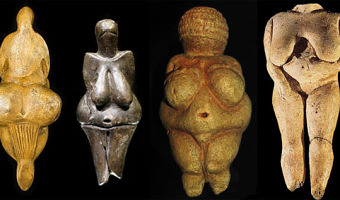
30000 BC – The Very First Sculptures

While data sculptures date back from the 1990s, the very first sculptures were Venus figurines: A Venus figurine is any Upper Paleolithic statuette portraying a woman with exaggerated physical features. The oldest ones are about 35,000 years old. Also see V.S. Ramachandran on the peak shift principle in art. Sources: Wikipedia article on Venus figurines. Left image from ancient-origins.net

Added by: Pierre Dragicevic. Category: Physical model  Tags: archaeology, sculptures, venus figurine, women
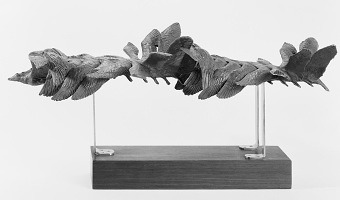

1887 – Marey's Movement Sculptures

Bronze sculpture showing the phases of the flight of birds, created by French scientist Étienne-Jules Marey in 1887 based on photographs. Étienne-Jules Marey was a pioneer in the study of dynamic phenomena and invented a variety of scientific and medical instruments, photography techniques, and temporal visualization methods. A wealth of information is available about him online. Sources: Russel Naughton (2007) Aviation and Aeromodeling History - Étienne-Jules Marey (1830 - 1904). Wikipedia […]

Added by: Pierre Dragicevic. Category: Physical model  Tags: temporal data


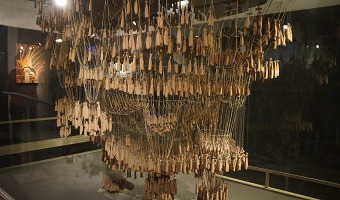
1889 – Gaudí's Hanging Chain Models

Spanish Catalan architect Antoni Gaudí disliked drawings and prefered to explore some of his designs — such as the unfinished Church of Colònia Güell and the Sagrada Família — using scale models made of chains or weighted strings. It was long known that an optimal arch follows an inverted catenary curve, i.e., an upside-down hanging chain. Gaudí's upside-down physical models took him years to build but gave him more flexibility to explore organic designs, since every adjustment would […]

Added by: Pierre Dragicevic. Category: Physical model  Tags: architecture, physical computation


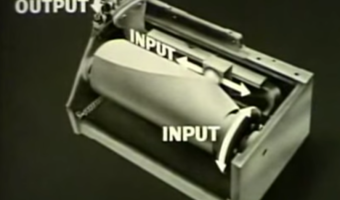
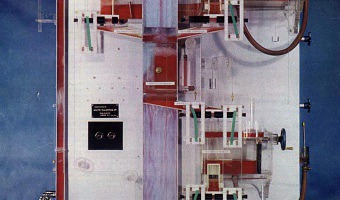
1930 – Mathematical Functions Embodied in Ballistic Cams

These cams are solid models of bivariate and univariate mathematical functions plotted in cylindric coordinates (left and middle images) and polar coordinates (right image). They were not meant to be visually examined, but were used in mechanical analog computers for aiming battleship guns during WWII. They were also called computing cams. Mechanical fire control aids started to be developed in the 1900s and and were still in use in the late 1980s. During WWII, they could solve multivariate […]

Added by: Pierre Dragicevic, sent by: Emmanuelle Beauxis-Aussalet & Yvonne Jansen. Category: Physical model  Tags: fire control, mathematical functions, physical computation


1949 – Moniac: A Hydromechanical Machine to Teach Economics

The MONIAC or Phillips machine is a hydromechanical analog computer built to teach basic economical principles using colored water flowing in transparent pipes. The machine was built in 1951 after electrical-engineer-turned-economist William Phillips and his economist colleague Walter Newlyn realized that flows were used as a metaphor to teach economics, but have never been made physical. Phillips is also known for his eponymous curves. Several MONIACs were built, and a working one is […]

Added by: Pierre Dragicevic. Category: Physical model  Tags: economics, education, flows, hydraulic, liquid, physical computation, simulation, water


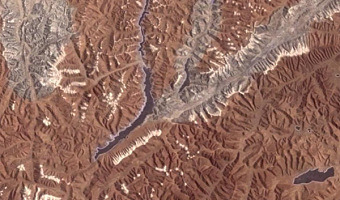
1999 – World's Largest Solid Terrain Model

In 2006, a mysterious 900x700m solid terrain model with military facilities was discovered by a German Google Earth user next to the Chinese town of Huangyangtan. It was quickly identified as a 1:500 replica of a disputed area in Tibet between China and India 2400km away, with perfectly matching orientation. Chinese authorities claimed the model was built 7-8 years earlier as a tank training facility. It is unclear whether the right image represents the same model. Sources: Newswatch (2011) The […]

Added by: Pierre Dragicevic. Category: Physical model  Tags: cartographic, large-scale, military, pragmatic, terrain model, walkable


2015 – Kohei Nakajima's Computing Tentacle

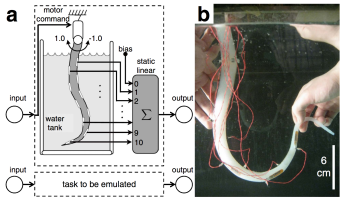
Kohei Nakajima and his colleagues argue that soft bodies are hard to control from a robotics perspective, but precisely because of their complex dynamics they can be used as information processing devices for solving hard computational problems. In a recent article they explain how they send inputs to a motor that wiggles a silicon tentacle, and read the system's output by sensing the arm's posture. I'm not entirely sure what's being calculated exactly, but the idea seems quite compelling. Also […]


2015 – Beeswax Maps Crafted by Bees

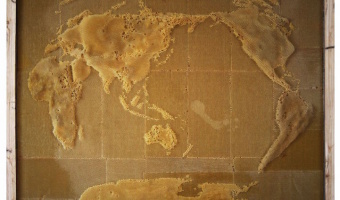
Artist Ren Ri uses beeswax as his medium for making geographical maps and a bee colony as the builder. This original project results in beautiful data visualizations collaboratively crafted by a human and a bee colony! Here's how it works: Because a colony will follow the queen bee and build a hive based on the pheromones that she releases, Ri is able to move the queen such that the others in the colony act accordingly. More details on the project can be found on the Flowing Data blog [1]: The […]

Added by: Fanny Chevalier. Category: Physical model  Tags: beeswax, cartographic, geography


2015 – Paper Cut Terrain Models

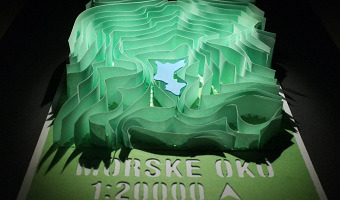
Paper models of terrain/landscape. Mapquest Elevation API is used to gather the elevation isolines and the paper layers are cut on a blade cutter machine. Source: Peter's DIY Blog

Added by: Peter Vojtek. Category: Physical model  Tags: cartographic, paper


2015 – Solid Model of Stellar Winds

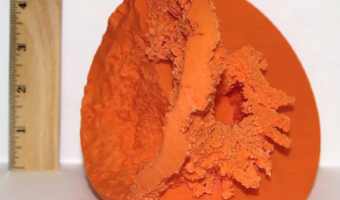
Scientists keep using solid models to help them better understand complex 3D data (here, an astrophysical simulation): They say this provides even more insight into what’s going on. “The ability to hold and inspect the 3-D printed models provides a new perspective on the WWIR’s geometry and an improved sense of the scale of the different structures,” they say. In particular, they say the model allows them to appreciate just how large the shockwave is compared to the stars and the distance […]

Added by: Pierre Dragicevic, sent by: Jean-Daniel Fekete. Category: Physical model  Tags: 3d printing, astronomy, digital fabrication, science, simulation