Tag: Physical Model

150 BC – Greek Orrery

An orrery is a mechanical model of the solar system. The left image shows the Antikythera, the oldest known orrery. The middle image shows a virtual reconstruction. The right image shows a contemporary orrery. The Antikythera mechanism is an ancient analog computer designed to predict astronomical positions and eclipses. It was recovered in 1900–01 from the Antikythera wreck, a shipwreck off the Greek island of Antikythera. The instrument was designed and constructed by Greek scientists and has […]

Added by: Melanie Bacou & Pierre Dragicevic. Category: Physical model  Tags: astronomy, greece, mechanical interaction, physical computation, pragmatic, science, time
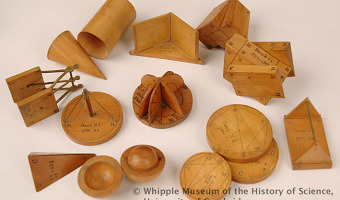

1750 – George Adams' Solid Geometry Models

During the 18th century, instrument maker George Adams built and sold solid 3D geometric models as educational complements to the 2D images found in Euclid's Elements of Geometry. As argued by a 18th-century author: It is almost as necessary as in mechanics, to exhibit the objects, whose qualities are to be taught; and to call in the joint assistance of the hands and eyes. According to the Whipple Museum of the History of Science, authors were already experimenting with paper models soon after […]

Added by: Pierre Dragicevic. Category: Physical model  Tags: education, geometry, science, wooden


1820 – Papier-Mâché Anatomical Models

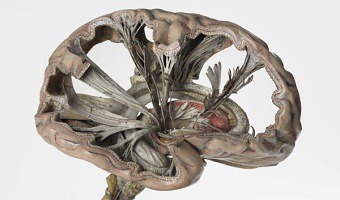
Left image: As part of its 2014 exhibition entitled Mind Maps: Stories from Psychology, the London Science Museum showcased this very accurate and intricate papier-mâché brain model from 1900 that shows path of nerve fibers. French physician Louis Thomas Jerôme Auzoux developed this technique around 1820 due to the shortage of human cadavers and wax models to study human anatomy. He was inspired by papier-mâché dolls that were common at the time. His models became popular in schools, […]

Added by: Pierre Dragicevic, sent by: Tobias Isenberg. Category: Physical model  Tags: anatomy, hand-made, model, papier-mâché, rearrangeable, science


1839 – Théodore Olivier's String Models

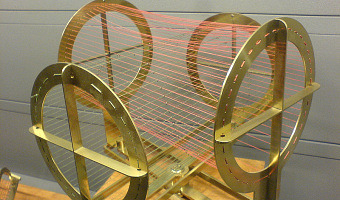
Between 1839 and 1853 the French mathematician Théodore Olivier created string models to teach and demonstrate descriptive geometry, some of which could be manipulated. He was a student of French mathematician Gaspard Monge, who invented descriptive geometry and was already illustrating his ideas with rudimentary string models. Photo above: intersection of two cylinders. Sources: Nicholas Mee (2013) Strings, Surfaces and Physics. Photo above taken in the Musée des Arts et Métiers in Paris, see […]

Added by: Pierre Dragicevic. Category: Physical model  Tags: geometry, mathematics, mechanical interaction, teaching


1880 – Klein's Mathematical Plaster Models

In the 19th century, mathematicians became interested in the question how mathematical functions look like. Felix Klein, a German mathematician, had several of such physical models in his lab in Göttingen, and popularized them in America when he brought a boatload to the World's Fair in Chicago in 1893. The photo above shows a model of a Clebsch surface from 1880, designed and presumably built by Adolf Weiler, Klein's grad student. It is kept today at the University of Göttingen. Sources: Photo […]

Added by: Yvonne Jansen & Pierre Dragicevic, sent by: Saiganesh Swaminathan. Category: Physical model  Tags: education, mathematical functions, plaster


2006 – Peter Jansen's Movement Sculptures

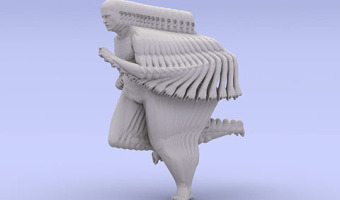
Dutch artist Peter Jansen creates sculptures of moving characters by merging successive snapshots into a single monolithic object. These are not physical visualizations as they do not display data, but the technique could certainly inspire the creation of physical visualizations for complex temporal data. The idea of merging time slices is reminiscent of the pioneering work of Étienne-Jules Marey in the 1880s on chronophotography. See our entry on Marey's movement sculptures. Source: Peter […]

Added by: Pierre Dragicevic. Category: Physical model  Tags: sculpture, temporal data


2009 – Distribution Plushies

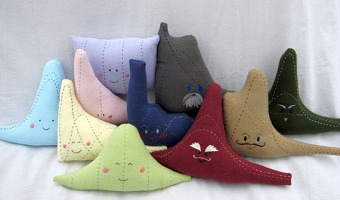
A commercial offer for a set of 10 plush distributions. Although not formally physical visualizations, they could in principle encode actual data. Source: web shop

Added by: Yvonne Jansen, sent by: Fanny Chevalier & Jean-Daniel Fekete. Category: Physical model  Tags: Plushies, statistics


2011 – David Bowen's Sea Wave Replicators

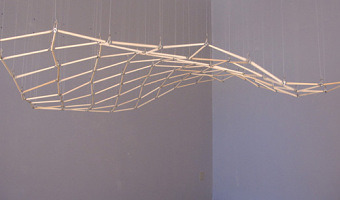
Top: Tele-present water by David Bowen is an actuated surface controlled by wires and servo-motors that replicates sea wave patterns measured in real time in a remote location. Bottom: Underwater is a larger-scale version created by the same author. Sources: David Bowen (2011) Tele-present water series. David Bowen (2012) Underwater series.

Added by: Yvonne Jansen & Pierre Dragicevic, sent by: Samuel Huron & Romain Vuillemot. Category: Physical model  Tags: sea, shape display, waves


2013 – Motion Structures: Videos as Space-Time Objects

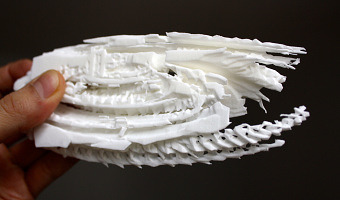
Everardo Reyes-Garcia from Université Paris 13 turns video sequences into space-time shapes that can be 3D printed. The sculpture above represents 5 seconds of the opening theme of Game of Thrones. Source: Everardo Reyes-Garcia (2013) Motion Structures. Related: Also see our entry 2006 – Peter Jansen's Movement Sculptures.

Added by: Pierre Dragicevic, sent by: Aurélien Tabard. Category: Physical model  Tags: 3d printing, digital fabrication, space-time cube, temporal data, video


2014 – Abyss Table - Scale Model of Deep Sea as Furniture

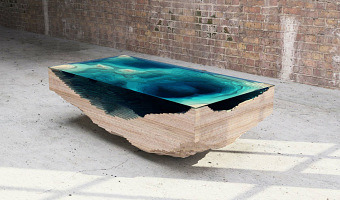
This table created by the furniture design company Duffy London is a geological cross-section of the sea shown with layered wood and glass sheets. Designer Christopher Duffy got the idea while visiting a glass factory and noticing that glass sheets darken as more layers as added, as does the sea. You can have this piece of furniture at home for £9,800. Sources: Duffy London (2014) Abyss Table. Nina Azzarello (2014) Duffy London layers the abyss table to look like ocean depths.

Added by: Pierre Dragicevic, sent by: Samuel Huron. Category: Physical model  Tags: cartographic, cartography, commercial, furniture, geography, sea, glass