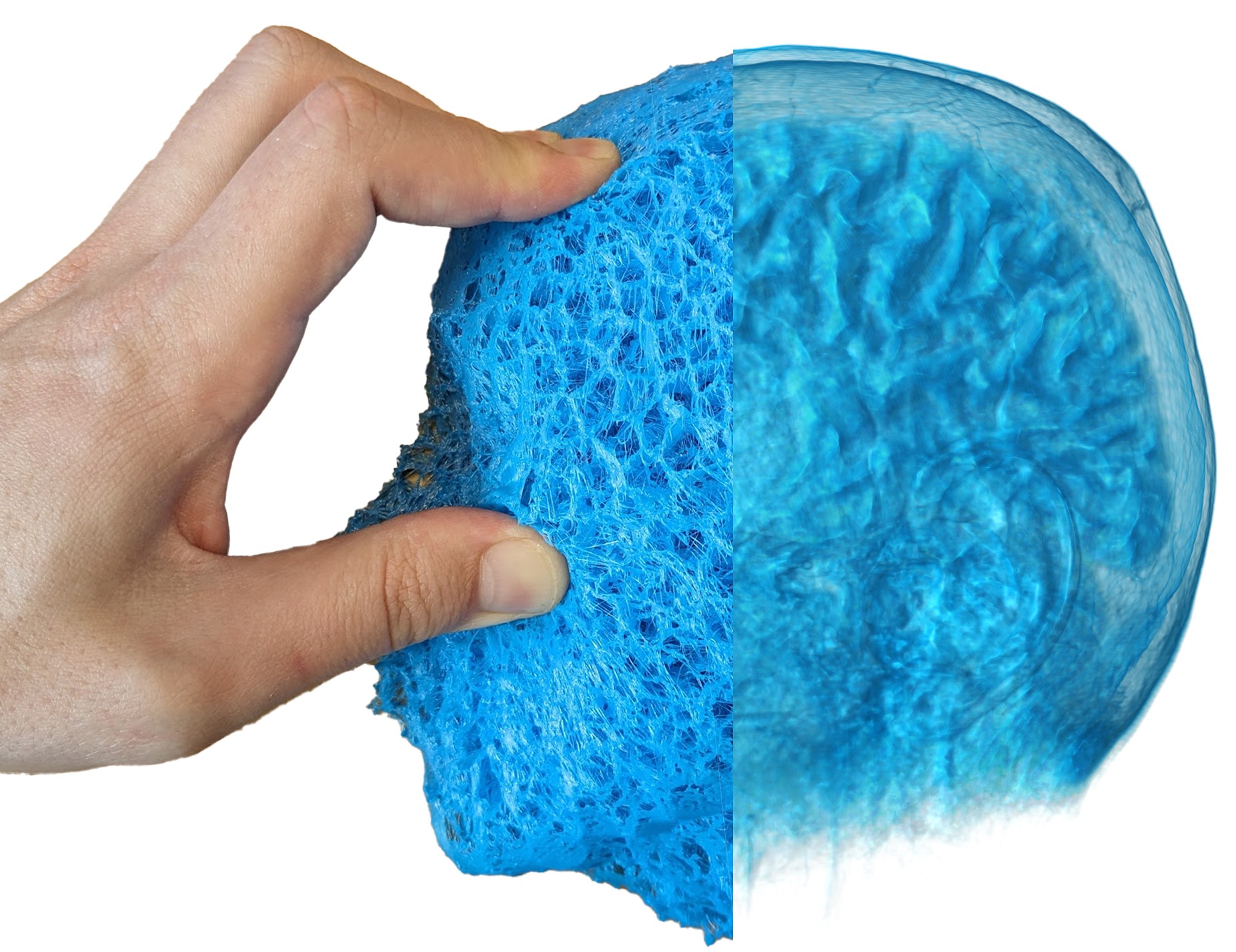
In their 2024 paper, Daniel Pahr and his colleagues introduced Squishicalization, a technique for physicalizing volumetric data by encoding scalar values as variations in local elasticity. Different regions of the physical object exhibit different levels of stiffness, allowing users to explore the internal structure through touch.
The image above shows an example generated from an MRI scan of a human head. The local densities of the 3D-printed structure (left) correspond to scalar values in the original volumetric dataset (right).
The authors describe a pipeline that uses customizeable, weighted sampling and Voronoi tessellation to generate sponge-like metastructures, which are fabricated using elastic materials and 3D printing.
Sources:
- Daniel Pahr, Michal Piovarči, Hsiang-Yun Wu, and Renata G. Raidou (2024). Squishicalization: Exploring Elastic Volume Physicalization. IEEE Transactions on Visualization and Computer Graphics, 31(9).
- Image from TU Wien – Squishicalization project page. Figure 4 in the paper.
Added by: Pierre Dragicevic.
Category:
Passive
Tags:
3D printing, volumetric, manipulable, elasticity