Tag: Archaeology

30000 BC – The Very First Sculptures

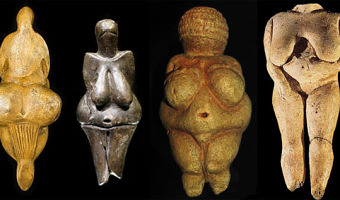
While data sculptures date back from the 1990s, the very first sculptures were Venus figurines: A Venus figurine is any Upper Paleolithic statuette portraying a woman with exaggerated physical features. The oldest ones are about 35,000 years old. Also see V.S. Ramachandran on the peak shift principle in art. Sources: Wikipedia article on Venus figurines. Left image from ancient-origins.net

Added by: Pierre Dragicevic. Category: Physical model  Tags: archaeology, sculptures, venus figurine, women

20000 BC – Ishango Bone

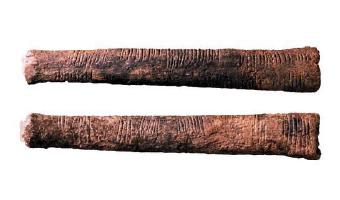
Before the earliest unambiguous numbers in Mesopotamia, there are earlier hints of prehistoric numbers. One is a 25,000-year-old bone from Ishango, a site on a river that flows into Lake Mwitanzige, part of the so-called headwaters of the Nile. This artifact bears three rows of marks that are divided into groups by wider spacing. The groups on the first row suggest the prime numbers between ten and twenty in ascending order; those of the second row suggest adding and subtracting one from ten […]

Added by: Anne-Laure Fréant. Category: Other  Tags: tally, bone, archaeology


5500 BC – Mesopotamian Clay Tokens

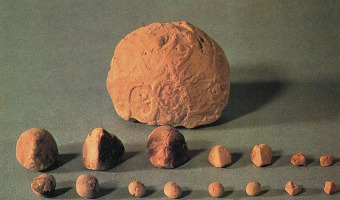
The earliest data visualizations were likely physical: built by arranging stones or pebbles, and later, clay tokens. According to an eminent archaeologist (Schmandt-Besserat, 1999): "Whereas words consist of immaterial sounds, the tokens were concrete, solid, tangible artifacts, which could be handled, arranged and rearranged at will. For instance, the tokens could be ordered in special columns according to types of merchandise, entries and expenditures; donors or recipients. The token system […]

Added by: Pierre Dragicevic. Category: Passive physical visualization  Tags: anthropology, archaeology, clay, mesopotamians, rearrangeable


1600 BC – Water Clocks

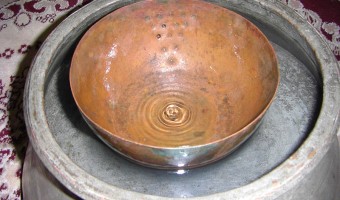
A water clock (or clepsydra) is an instrument where time is measured by regulating a flow of liquid. The oldest water clocks simply consisted of a pierced bowl placed in a larger pot filled with water (see left image, Persian artefact from 400 BC). These existed back in the 16th century BC. The passage of time was observed by counting how many times the bowl overflowed and its content had to be poured back in the larger pot. This was used for example in Persia to ensure fair irrigation […]

Added by: Pierre Dragicevic. Category: Measuring instrument  Tags: archaeology, water, water clock


500 BC – Pebble Voting

The earliest participatory visualizations were probably voting systems. Voting in Greece was introduced in the 5th century BC. Adult male citizens were invited to express their opinion by dropping a pebble in an urn: a white pebble meant "yes" and a black pebble meant "no". Sometimes two urns were used. The left image is a detail of a Greek wine cup from the 5th century BC, and is one of the earliest known depictions of the act of voting. The middle image is a modern reconstruction from a TV […]

Added by: Pierre Dragicevic. Category: Passive physical visualization  Tags: archaeology, democracy, greeks, participatory, voting