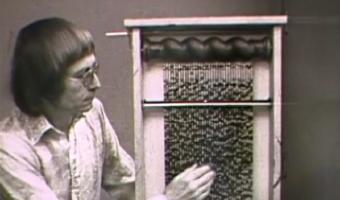
Stuart Anstis, a professor of psychology at UCSD, built this device for studying perceptual illusions. I made this movie clip in the 1970’s, when I had more hair than brains. Randomly-spotted vertical rods were held in a frame so that they could move up and down along their own length but not sideways. When I slowly pulled the rug out from under them, they fell in sequence, so that a contour (defined by vertical motion) moved to the left. I then turned the machine upside down and cranked the […]
Stuart Anstis, a professor of psychology at UCSD, built this device for studying perceptual illusions.
I made this movie clip in the 1970’s, when I had more hair than brains. Randomly-spotted vertical rods were held in a frame so that they could move up and down along their own length but not sideways. When I slowly pulled the rug out from under them, they fell in sequence, so that a contour (defined by vertical motion) moved to the left.
I then turned the machine upside down and cranked the handle. The rods, resting on the barley-sugar twist table leg, moved up and down sinusoidally, producing a travelling wave of second-order motion. Since this ‘motion grating’ was defined by texture, not by luminance, a Reichardt motion detector would be blind to it. Observers could see it quite clearly. I looked for a motion aftereffect but found none.
Sources:
Stuart Anstis (2012) Early Study of Second Order Motion. Quote and video by Stuart Anstis. Related: see our other entries on mechanical interaction.