Death of the desktop

This page presents the diverse set of submissions we received for this workshop.

Scenarios

2100 : brain improved pre-attentive capabilities
Submitted by: Fred Vernier, LIMSI-CNRS
Tags: brain pre-attentive 

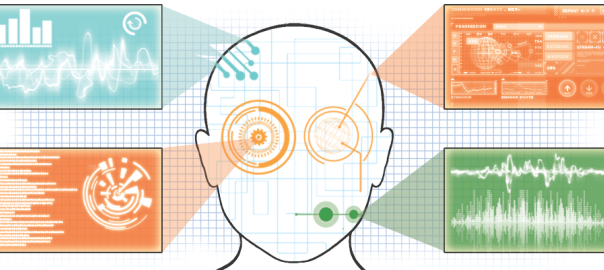
As brain-computer interaction became available it was clear people didn’t want more information gushing toward their brain liked fire-hose aimed at a teacup  (see Dilbert comic strip) but a piece of electronic plugged near the back of the brain found a much clever way to improve our capabilities : increase pre-attentive features we are able to recognize ! The processor take information flow directly at the start of our optical nerve and process all kind of computer vision processing in parallel. Results are then added to the normal flow of information our brain receive from tour eyes. If this technology was first created to give back sight to blind people it allows now to distinguish an unhappy face among 200 happy one like a red square among blue ones. Fortunately the pre-attentive processor can be switched off or be tweaked to reveal boolean combination of features (with no interference between features obviously !). Anyway anyone can now have a look at a very messy scatterplot or any hairball graph and patterns just pop up to our eyes 2.0.

20π
Submitted by: Caroline Claisse / Kevin Walker, RCA
Tags: grey inflatable null occult 
Submitted pdf

We humbly attach here the results of an Exquisite Corpse experiment conducted with our students, envisioning a grey-sky future of small people & large computers, nasal and inflatable and null future visualisation strategies. We note also an increasing convergence with the practice of ‘visualisation’ as practiced by witches and druids in the west of England.

2029 – The Cynical Ergonomist: A day in the life of a police intelligence analyst in 2029
Submitted by: Chris Rooney, Middlesex University
Tags: Ergonomics 
Submitted pdf

In a popular dystopian future where life is tough for young adults, there is still street crime, and still a need for crime analysts.  There was once a time where analysts used screens no bigger than 17 inches, and visual analytic systems simply supported decisions, rather than making their own.  Let’s jump to 2029 and spend a day with police crime analyst Alex Murphy, who doesn’t always get on with modern technology, to see how things have changed.

Future Directions for Visualisation
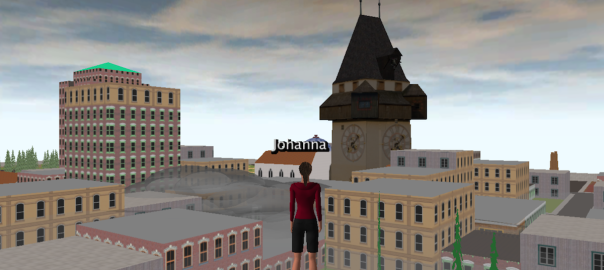
Submitted by: Keith Andrews, Johanna Pirker, and Vedran Sabol, Graz University of Technology, Know-Center Graz
Tags: explanatory exploratory future user interface visualisation 
Submitted pdf

The design of a visualisation invariably depends upon the task(s) and the target user group it is designed to support. Exploratory and explanatory visualisations generally require different considerations. We consider the future of visualisations from this perspective.

The future of information representation may simply be less of it
Submitted by: Jam, Unruly.co
Tags: adoption bioreadout consequences credit display health interface insight product display states wearable 
Submitted pdf

It’s easy to think of information visualisation in terms of consumer products, brands and advertising but their adoption will reach much further. New industries, schools, even militaries will invariably adopt visualisation systems for better or worse. What happens when they do?

Splinter in The Mind’s Eye
Submitted by: Michael Rawling, Unruly.co
Tags: brain brain interface cyborg EEG ElectroEncephaloGram mind 
Submitted pdf

…ElectroEncephaloGram(EEG) technologies and our ability to technologically sense electric fields evolve significantly past where they are now.

Meanwhile human brain to computer communication using body-embedded-systems becomes De Rigueur, becoming extremely sophisticated and compact: we begin to embed these in our bodies – our communication, wayfinding and augmented analysis and processing are encapsulated in ourselves.

Your Will is the command for your own Personal Organic Network(PON)…

It matters little where the data, connection and files are as the interface is your own body interfaced invisibly with the Network at large – functioning as as one: smoothly, invisibly – a question is asked…and answered in imagined visions in the canvas of the mind.

Visionaries Don’t Use Desktops
Submitted by: Dan Keefe, University of Minnesota
Tags: creativity post-desktop spatial user interface virtual reality 
Submitted pdf

I’m interested in: creative design, finding a needle in a haystack, explaining a complex medical treatment to a worried patient, delivering healthcare, helping different cultures understand each other, helping families stay connected, making scientific discoveries, art. For these, and for the visionaries who work on these tasks, the desktop is already on life support.

Some Future Scenarios for ‘in the wild’ Visualisations
Submitted by: Jose J. Cavero Montaner; Michel Wermelinger; Annika Wolff, Computing and Communication Department. The Open University. UK.
Tags: common objects large scale augmented reality natural devices 
Submitted pdf

Migration from desktop-based to alternative out of the desk visualisations, could help to overcome some of the issues that are related to traditional screen representation problems. But simultaneously, it represents a challenge in which many technical and ethical questions have yet to be answered. Some thoughts about how visualisation outside the desktop could be applied are presented through three different categories: common objects, large scale augmented reality and natural devices.

Projector Display Systems in Visualization
Submitted by: Sriram Karthik Badam and Niklas Elmqvist, Department of Computer Science and College of Information Studies, University of Maryland, College Park, MD, USA
Tags: gestures interaction post-WIMP interaction. projector displays proxemics visualization 
Submitted pdf

Modern films such as the Iron Man series, Avengers, and Pacific Rim best exemplify visual interface designs that are futuristic, follow fluid interaction guidelines, and are yet not too distant. These movies show interaction models designed for direct manipulation of real and virtual objects in holographic projections, and also embodied interaction in completely immersive environments. Furthermore, these imagined interfaces have their own envisioned application domains ranging from casual computing, information browsing to creative design and even analytics. A common aspect among these many imagined futuristic user interfaces (FUI) is projection of different types: (1) head-mounted, (2) holographic, and (3) immersive projection. In this paper, we imagine the interaction models that can best-fit each of these projector display types when they are adapted to visualization and visual analytics. For this, we consider interaction models that go beyond a desktop to utilize implicit aspects within the environment such as proxemics and explicit actions through direct manipulation, gestures, tactile, and other forms of multi sensory feedback. We borrow application scenarios from the aforementioned movies and the general guideline behind our discussion is that projection type guides the interaction design.

A Dystopian Preview of How Visualization will Adapt to the Split of Society in ”Have” and ”Have-Not”
Submitted by: Pascal Goffin, Philippe Goffin, Inria, ETH Zurich
Tags: digital glasses Dystopia society change walls as displays 
Submitted pdf

We are writing the year 2100, due to excessive usage of monitors human eye capability has dramatically diminished and the ability to speak has vanished. Humans are wearing digital glasses to see the world and get predictive information, and are communicating through instant thought messaging captured by neuro-captors. This evolution has plunged our society as we know it into a “Have” and “Have-not” society where the rich can chose what they want to see and the poor are submerged and flooded with biased information with the sole goal of making the rich richer and the poor poorer.

Metaphor and Rumour
Submitted by: Greg McInerny, Oxford
Tags: Charts Colour data Glyphs Maps Symbols 
Submitted pdf

In the society that followed, knowledge demanded such precision that all decisions were based on analysing hundreds of possibilities using thousands of calculations and producing millions of data. In the course of time, the impracticality of a growing library of data led to the employment of Polyglots who curated the data, creating encyclopaedias and then charts describing their contents.

Architectural Interactive Glass, Layering Devices and Collaboration
Submitted by: Richard, Brath
Tags: Collaborative visualization Layered devices Visualization walls 
Submitted pdf

Desktops can be replaced with collaborative environments utilizing a combination of large scale screens for overviews, collaborative analysis and presentation; mobile devices for focused interactions and local exploration; and combinations of devices for layered visual composition.

Warning Signs of the Future
Submitted by: Oriana Love, Dee Kim, Russ Burtner, Lyndsey Franklin, Ian Roberts, Pacific Northwest National Laboratory
Tags: personal visualization warning 
Submitted pdf

Information analytics has been democratized. Personalized visualizations are prevalent and surround us… literally. Information auras housing our personal data aid in interactions with others by surfacing current topics of interest – our likes and dislikes. Rather than being tethered to smartphones or other devices, our auras house all of our information and we interact naturally through gesture, mental interaction and tangible computing. Our relevant data is made visible in our aura based on whom we are interacting with. While in groups, our auras fuse based on commonalities and topics of interest in conversation and an intersection of values and passions. Visualizations showing topical convergence, divergence and procedural guidance emerge. It becomes more time efficient to work with others using these highly personalized collaborative aura overlaps than unstructured conversations of the past. Introverted behaviors have become the social norm. Each individual’s private, personal data is “underground” or hidden to protect our information from others.

The desktop is dead, long live the desktop! – Towards a multisensory desktop for visualization
Submitted by: Jonathan C. Roberts, Joseph W. Mearman, Panagiotis D. Ritsos, Bangor University
Tags: haptic data visualization interaction techniques Multisensory visualization 
Submitted pdf

“Le roi est mort, vive le roi!”; or “The King is dead, long live the King” was a phrase originally used for the French throne of Charles VII in 1422, upon the death of his father Charles VI. To stave civil unrest the governing figures wanted perpetuation of the monarchs. Likewise, while the desktop as-we-know-it is dead (the use of the WIMP interface is becoming obsolete in visualization) it is being superseded by a new type of desktop environment: a multisensory visualization space.

This `space’ is still a personal workspace, it’s just a new kind of desk environment.

Our vision is that data visualization will become more multisensory, integrating and demanding all our senses (sight, touch, audible, taste, smell etc.), to both manipulate and perceive the underlying data and information.

An Interaction Continuum for Visualization
Submitted by: Tobias Isenberg, Inria
Tags: Display environments for interactive data exploration and visualization 
Submitted pdf

It is the year 2039, the desktop is not dead, and it does not look like this situation will change for a while. In any practical application domain in which data visualization is used, the desktop remains to be one of the most important tools for data exploration, analysis, and processing. Since the year 2014, non-desktop platforms for data exploration including large displays, immersive environments, tangible controls, and mobile devices have found their place for data visualization applications—but they have not and will not replace the desktop in many practically relevant tasks. Instead, researchers have finally begun to work toward an interactive visualization continuum that allows researchers and data analysts to transition between the different platforms and to use the tools for those tasks they support best: the desktop for in-depth, single-user analysis and novel platforms for group discussions, mobile data access, and/or good spatial perception.

Big Dada: From visualisation to experience
Submitted by: Kevin Walker & Caroline Claisse, Royal College of Art, London
Tags: art dada data multimodal multisensory surrealism 
Submitted pdf

Our approach to the future of visualisation focuses on experience as a central concept, questioning what is considered information or data, moving to multimodal, multisensory forms of representation, and redefining the designer as an artist with a critical perspective who works with a range of media and materials.

It’s not so much ‘death of the desktop’, more ‘death of the desk’.
Submitted by: Rob Radburn, Leicestershire County Council
Tags: Local Government 
Submitted pdf

For many the next few years will see the end of local government in England as we know it. But it won’t be the end of local government. It will though deliver its services in a radically different way.

For visualisation the issues are reassuringly familiar, but still unanswered by the discipline: how do you make sense of ‘Big Data’ to make better decisions across a diverse audience.

Sewn with Ariadne’s Thread – Visualizations for Wearable & Ubiquitous Computing
Submitted by: Panagiotis D. Ritsos, Joseph W. Mearman, Andrew Vande Moere and Jonathan C. Roberts, Bangor University, Bangor University, KU Leuven, Bangor University,
Tags: mixed reality ubiquitous computing visualization wearable computing 
Submitted pdf

Lance felt a buzz on his wrist, as Alicia, his wearable, informed him via the bone-conduction ear-piece – ‘You have received an email from
Dr Jones about the workshop’. His wristwatch displayed an unread email glyph icon. Lance tapped it and listened to the voice of Dr Jones,
talking about the latest experiment. At the same time he scanned through the email attachments, projected in front of his eyes, through
his contact lenses. One of the files had a dataset of a carbon femtotube structure.

– A short story about the synergy of visualization, wearable and ubiquitous computing, and augmented/mixed reality.

Interactions with Mixed Reality Systems
Submitted by: Bireswar Laha, Charilaos Papadopoulos, Arie E. Kaufman, Dept. of Computer Science, Stony Brook University
Tags: 3D interaction 3D visualization Augmented Reality Displays mixed reality virtual reality 
Submitted pdf

We envision a mixed-reality future where there will be computers everywhere and all around us. We shall experience and regularly use virtual, augmented and hybrid reality systems, exploring information in an amalgamation of the physical and computer-generated space. These systems will be integrated across geography and will deliver powerful content seemlessly both at home and at work. Interaction opportunities with such systems are numerous and new modalities become available with each day. In coming years, we believe interaction with these systems will become a lot more standardized in both 3D spatial and 2D mediums. The interaction designs will borrow significantly from our daily natural interaction metaphors, supported by proven designs of techniques from the human-computer interaction community. Multi-modal and multi-party visualization will be made possible by the availability of commodity level display and interaction devices, supported by strong network connectivity capable of delivering vast amounts of data in real-time. This will result in transformative progress in the sciences and will significantly improve the quality of our lives.

The Desktop is Dead — Long Live the Workstation?
Submitted by: Aaron Knoll, SCI Institute, University of Utah
Tags: cloud computing HPC large memory remote visualization SMP workstation 
Submitted pdf

We explore shared-memory workstations as compelling alternatatives to desktops and small clusters, for purposes of scientific visualization. With new manycore CPU hardware on the horizon and the current popularity of large-memory “fat nodes” in HPC, SMP workstations are poised to make a comeback. These machines will augment, not replace, HPC and cloud resources, providing both remote visualization and more personalized vis labs. They will be accessible anytime, anywhere on any device, running a single operating system, capable of handling all but the absolute largest scientific data. We describe current state of the art, emerging trends, and use cases that could make the SMP workstation the dominant driver of high-end scientific visualization in the next decade.

Showing Important Facts to a Critical Audience by Means Beyond Desktop Computing
Submitted by: Tim Lammarsch, Wolfgang Aigner, Silvia Miksch, and Alexander Rind, Vienna University of Technology
Tags: Information Visualization Science Fiction Visual Analytics 
Submitted pdf

Recent research in Visualization has focused mostly on data analysis systems for domain experts, but also considered presentation to external people in the form of storytelling. The established directions assume that the target audience has in inherent interest in the facts to be discovered, sometimes even to the point of them being willing to learn how to operate a complex visualization system and spend considerable time and effort. In reality, sometimes the opposite is true: people unwilling to face an inconvenient truth actively avert their eyes. As a solution, we propose the presentation of facts by experts who manage to gain a limited amount of attention by means of rapid and expressive visualization. Using conventional desktop systems, this method is hard to implement, but new visual channels will open up new possibilities.

Complexity, Magic, and Augmented Reality: From Movies to Post Desktop Visualization Experiences
Submitted by: Steven Drucker, Microsoft Research
Tags: Augmented Reality Complexity Magic 
Submitted pdf

While we can look to Hollywood for inspiration about the future of visualization and interaction with data, we must be cautious to recognize some fundamental differences between movies and reality. We explore three areas: complexity; magic; and augmented reality and examine their uses both within movies and potential uses on post-desktop visualizations.

cetonia – a dynamic swarm at your fingertips
Submitted by: Wesley Willett, Inria
Tags: Analysis Anywhere Remote Manipulation World Integration 
Submitted pdf

At barely 1.5 centimeters across, each Cetonia scarab is a marvel of precision engineering. Designed from the ground up for agile flight, their integrated hydrogen chambers and a high-efficiency hover mode permit 15+ minutes of air time between charges. The hueSHIFT carapace is capable of displaying over 22 million possible colors and provides clear visual feedback in day or night with visibilities up to 1.5 kilometers. Integrated camera and sensor arrays permit full 6D reconstructions with composition profiling. From your wrist or a personal field station you can quickly deploy flights in automated formations to survey, measure, record, and manipulate almost anything.

Flash to order now.

http://www.wjwillett.net/content/cetonia/

Everybody Needs Somebody
Submitted by: John Fass, Royal College of Art
Tags: data environments digital objects display Interfaces materiality physical interactions physical visualisation social network models 
Submitted pdf

This practice-led design research explores the deployment and use of a physical, non-digital visualisation tool to model personal social networks. The emphasis is on how people choose to represent their networks, what they choose to show, and how the process of creating physical representations contributes to the uncovering of an otherwise invisible set of relations. Research focus is on the construction of narrative meaning in a social context by a mixed sample of participants, and the development of instruments to support and mediate this construction. The research is intended to shed light on how people construct personally meaningful narratives about their social networks by creating physical visualisations of them. Experiencing personal networks physically by constructing them from everyday materials brings them into clear sight; to the forefront of haptic and phenomenological consciousness in ways difficult to emulate with computer monitors and touch screens.

Enabling Spherical Vision
Submitted by: Karen Bemis, Alfie Abdul-Rahman, Min Chen, Saiful Khan, Eamonn Maguire, and Simon Walton, (1) Rutgers University and (2) Oxford University
Tags: 3D volumetric 
Submitted pdf

We envision the following grand challenge: To develop a technology that enables users to visualize a spherical and volumetric environment without using traditional display devices as a medium. This technology will of course be realized step-by-step, for example, (i) first enabling direct simulation of any part of the pathway between optical nerves and visual cortex, bypassing the eye; (ii) next facilitating perceptual formulation or cognitive reconstruction of a single flat image; (iii) then a spherical vision; and (iii) finally a volumetric vision.

Statements

2019: Hidden Workstations Everywhere — Personal Computing for Visualization in the Mature Cloud Era
Submitted by: Aaron Knoll, University of Utah
Tags: cloud CPU HPC remote visualization shared memory workstation 
Submitted pdf

In just five short years, visualization, HPC and data analysis users will need to constantly remind themselves which resource they’re working on as they run dozens of virtualization clients on devices from tablets and laptops to wristwatches and headsets. The desktop will not be truly dead — just lonely — living either in an empty office or in a machine room. But it will be busy. New CPU and manycore architectures, cheap memory, and the demands of scalable ray tracing and database algorithms will bring about a return of mid-scale shared-memory computing. Visualization clusters and cloud resources will increasingly consist of “fat nodes”, operated interactively as opposed to in batch. For the foreseeable future, the occasional need for root access, large displays and a real mouse and keyboard to interact and code will bring researchers back to the office to work on their personal machines, before heading off to the next conference to actually do work on them.


2020 -Welcome to the Visual Home: BC Architects, planners and researchers prototype visualization services for informative buildings
Submitted by: Lyn Bartram, Simon Fraser University
Tags: infrastructure personal visualization sustainability ubiquitous data 

What happens when data are ubiquitous in our lives, our homes are completely networked, and information pertinent to decisions we make in daily life are virtually at our fingertips? The approach that hallmarked the first decades of the digital home has been to supply residents with an assortment of standalone apps,  websites and social media for retrieving, monitoring and and analysing data from a plethora of sources, and to design specialised views that are particular to devices like tablets and phones.  But this doesn’t work in an increasingly fluid and dynamic information landscape where information-driven decisions  happen throughout the home in the course of daily life. New light technologies let us paint displays onto the surfaces and materials in our homes, embedding visualization capabilities into the very fabric of our living spaces, and extending the affordances of a display to the actual building envelope, appliances and furniture that comprise that home. Visualization has now become both a functional and an aesthetic consideration in how we design and use our living spaces: instead of the quaint, over-automated “Smart home” of the 1990s, we now have “informative homes” capable of receiving, capturing and communicating data right at the points, times and activities when we need it. Instead of getting regular but infrequent reports of our data (an energy bill, a school report card, the financial records of our building council), the informative home subscribes to data feeds and visualization services that can mash-up and slice the data into meaningful forms based on use and constraints specified by the resident. Architects are working with visualization researchers, municipal planners, and social scientists to explore how well-known principles of automated visualization design can transfer to this broader space, extending the notion of a display to include surface properties (e.g. a stainless steel fridge door), contexts of use (e.g. a kitchen backsplash, a social table) and aesthetic and affective constraints (the “persuasive meter”. )

2014: The Movies Have Lied To Us
Submitted by: Danyel Fisher, Microsoft Research
Tags: film infovis james bond jurassic park movies tom cruise 

The movies, it turns out, are a terrible model for data visualization.

Let me step back a moment. If I want to know what the future of, say, intelligent agents might look, I have a lot of choices. KITT from Knight Rider, or the Star Trek computer, or HAL from 2001, or any of a thousand other films and television shows will all give me examples of how speech recognition and intelligent agents might look. A designer of current systems can push back, or pick points on the spectrum—“I’d think it can be more mechanical, less humanoid.”
What about computer graphics? The Holodeck. R2D2 projecting the Princess Leia. Infinite zooming in Blade Runner. 3D worlds in Jurassic Park and a million other movies.

And so it goes for lots of developing technologies. Flying cars and self-driving cars. Robots and tablet computers. Movies have shown us visions of the future for power plants, and long distance transport, and food preparation–and even for how doors might work. Film directors, screenwriters, and effects teams have done a wonderful job of portraying the a computerized, high-technology future.

Now, since the beginning, we’ve all understood that computers are very good at presenting and storing information- Or, at least, we’ve believed that we understand that. Sadly, we have only the poorest of examples to work from.

Not long after Minority Report came out, the interface was the talk of the conference. Who wouldn’t want to be Tom Cruise, solving crimes with a stern look and conducting data to the soothing strains of classical music? It took only a few days to notice the flaws—the tremendous physical strength required to use a vertical work surface; the fact that the surface only showed a dozen or so video clips.

Movies often bring in a ‘visualization’ to show that Real Hard Science is happening: Tony Stark not only manipulates a Periodic Table floating in the air (for completely mysterious reasons), but has a cockpit full of virtual circular bar charts with bouncing indicators.

James Bond casually looks at an information display as M grabs data off the table and throws it onto a wall-size screen. It’s a picture of the villain, a few photographs of his miscellaneous personal belongings, and a map with one spot of color, showing where the next travel montage will bring us. Around the side are unreadable, scrolling text. For extra science, some of the text appears to be computer code.

Data turns to Captain Picard, spouting smooth technobabble while numbers scroll past his screen—and in the Matrix, screens of meaningless numbers scroll past as a character calmly explains that the raw data is easier to read. John McClane (Die Hard 4) takes in the big screen at the CIA, which is filled with meaningless charts, randomly-zooming maps, and one counter, slowly counting down. When the counter goes to zero—we’re certain—terrible things will happen. Batman sits in his cave, watching two hundred independent video feeds at once. Suddenly, the Bat-Computer makes a decision, and every screen changes over to a single scene that moves the plot forward.

There are exceptions: scientific visualization and map-based presentations can be reasonably presented, with approximately one dimension of data. Essentially, the visualization gets to show one fact, such as “it’s over here.”

As soon as we want to represent anything remotely data dense, we need to slow down a great deal. Hans Rosling takes four minutes to show his famous animating charts: it takes a full minute to just explain the axes, another to describe what different areas of the chart mean. Even then, the presentation can only show the very basic decision of “things that are close together” vs “things that are far apart.”

By their very nature, movies will never offer us the technological innovation we might be seeking here. High-quality, expert-oriented data visualization require more time, more precision, and more expertise than a movie screen has time to show us. Movies will continue to simplify visualization to the point of absurdity: spaceships become dotted outlines; blinking lights will streak toward other dotted lines, which will be destroyed in a flash of red. Information visualization researchers, then, need to learn to operate independently from Hollywood; the needs of movies do not speak to our field.

This is a bitter truth to swallow. Our fellows in some other fields of computer science have long since accepted it: representations of OS operations (“I know Unix!” from Jurassic Park; the 3D environment in Disclosure); of programming languages; and even of search engine rankings (searching for “Job”, in the Saint, finds one hit) are all absurd. But to the extent that visualization is informed by design, we wish, I think, to draw inspiration from designers working in different fields, solving different problems. (Then again, infographics are also doing a poor job of informing the field.)

My vision of “beyond the desktop”, then, is a pessimistic one. We know a lot about desktops: how to interact with them rapidly, how to use them efficiently. We have placed enough technology in them to be able to manipulate up to a terabyte of data, which seems to cover many interesting problems; we have connected them to fast networks. While it’s important to be able to build lightweight dashboards for phones, and make data browsable on a tablet, the desktop is a powerful tool.

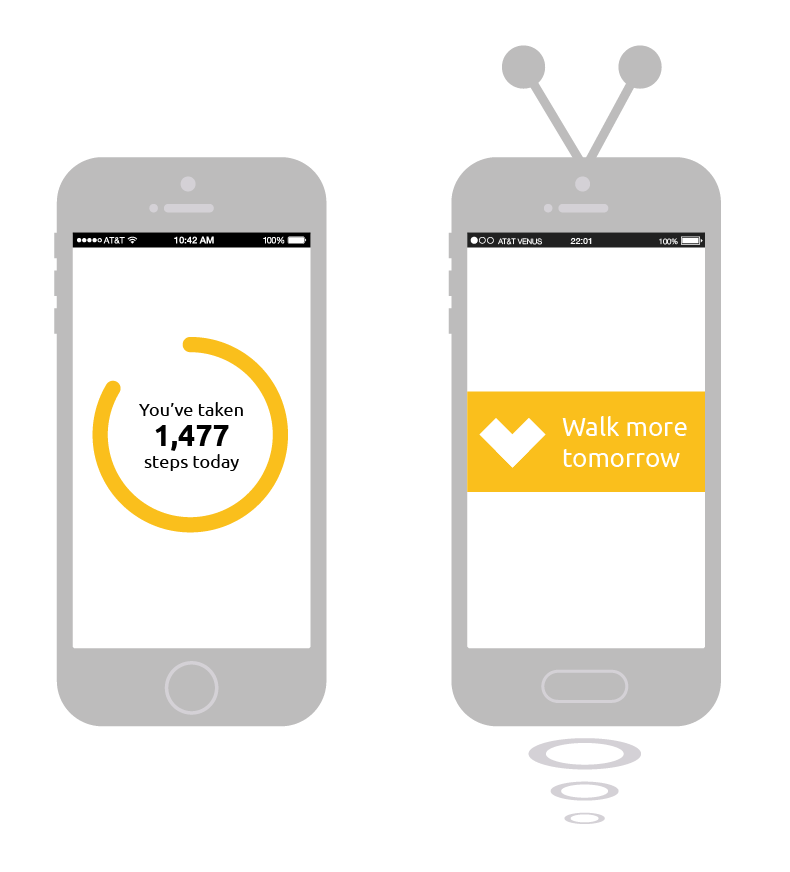
Don’t get me wrong: my work on Cambiera (Isenberg et al) convinced me that touch manipulation can feel smooth and efficient, and has an important place. Fitbits—showing just a few characters and a blinking light—are surprisingly good at motivating lightweight behavior. And I hope that wall-sized displays can provide new forms of richness.

But we’re going to have to get there the old-fashioned way: not through adapting ideas from our imagination, but by writing code, failing, and trying again.


Abstracts

2024 – Wearable Visualization Can Provide Sporting Advantage
Submitted by: Jason Dykes, City giCentre, University London
Tags: wearable textile visualization sport performance navigation 

We establish the positive effects of visualizing information about current performance and location on sports garments using TechStyle – a densely woven highly wicking fabric that permits visualization. Our design uses broad single-colour bands near the cuffs of long-sleeved garments to aid navigation. Lighter colours on the left and right sleeves are used to direct wearers left or right respectively. Additional bands on the forearm are used to show heart-rate and power output as detected by the fabric.
These subtle means of informing wearers of their location and performance were tested ‘in the wild’ in four contexts involving three sports and both professional and recreational levels of performance: in orienteering at a training day, in triathlon at a regional event and in cycling with the UK Youth Development Squad and on a recreational ride during Le Tour de VIS 2023.
In the first case (orienteering/performance) all athletes wore TechStyle with a visualization group outperforming a control group in terms of the extent to which actual race times improved upon times predicted using historical performance data. Analysis of literals suggests that the navigation visualization was beneficial. In the triathlon event (recreational) ten athletes wore TechStyle and our qualitative analysis showed no effect in terms of navigation and no benefit to the performance visualization. Qualitative analysis in the performance cycling case indicated that the feedback on heart rate was useful to riders and an improvement upon the existing ways of accessing this information. Cyclists suggested alternative means of providing this information both numerically and graphically and requested a time series. However, the navigation aids were not deemed to be beneficial. Qualitative analysis in the recreational cycling case found the opposite – cyclists considered the navigational aids to be effective and useful but not the performance indicators. The riders liked the jerseys and the fabric nevertheless and suggested the possibility of a placebo effect on performance.
We conclude that TechStyle can provide advantage in some sporting contexts, even with relatively simple graphical depictions of data. The extent to which this is the case will depend upon the event, level of performance and priorities of the participants. This suggests the need for designs that are more context and perhaps athlete specific or more flexible than those used here to improve performance more widely.

2139: The Dynamic Data Tattoo: Data at your fingertips – or anywhere else on your body
Submitted by: Petra Isenberg, Inria
Tags: body sensing data tattoo personal information management 

Abstract

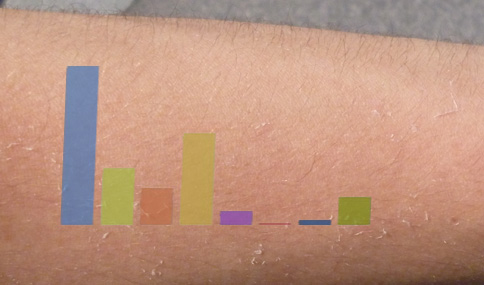
In this electronic document, we present our latest results in regards to the development of the dynamic data tattoo. The dynamic data tattoo is a semi-permanent body modification made out of permanent data ink. The data ink can be placed on any part of the body and take on any color. It is connected through micro-particles to the typical internal and external body sensors people carry nowadays. Based on the data collected by the sensors and the representation information sent by the sensors, the ink changes color and can, thus, display any type of data and visualizations thereof. If no longer needed, the data tattoo can take on a person’s regular skin color and, thus, completely vanish. We show how one can program data tattoos through various body sensors, how to interact with them to modify the display, and also detail perceptional algorithms that ensure maximum perception quality, no matter where on the body the data tattoo is placed. Further experimental results prove how immediate access to one’s body sensor data (without the use of external devices) can result in dramatic increase in life satisfaction and we conclude with a report on success stories in the medical domain.


Paper submitted to VIS 2139. Full text pending science-crowd-assessment.